I presented this talk (online) at the Roguelike Celebration on October 17, 2026.
For the clever but awkward layout of these slides which I used in my talk, see here. (Interstitial images by Giovanni Battista Piranesi.)
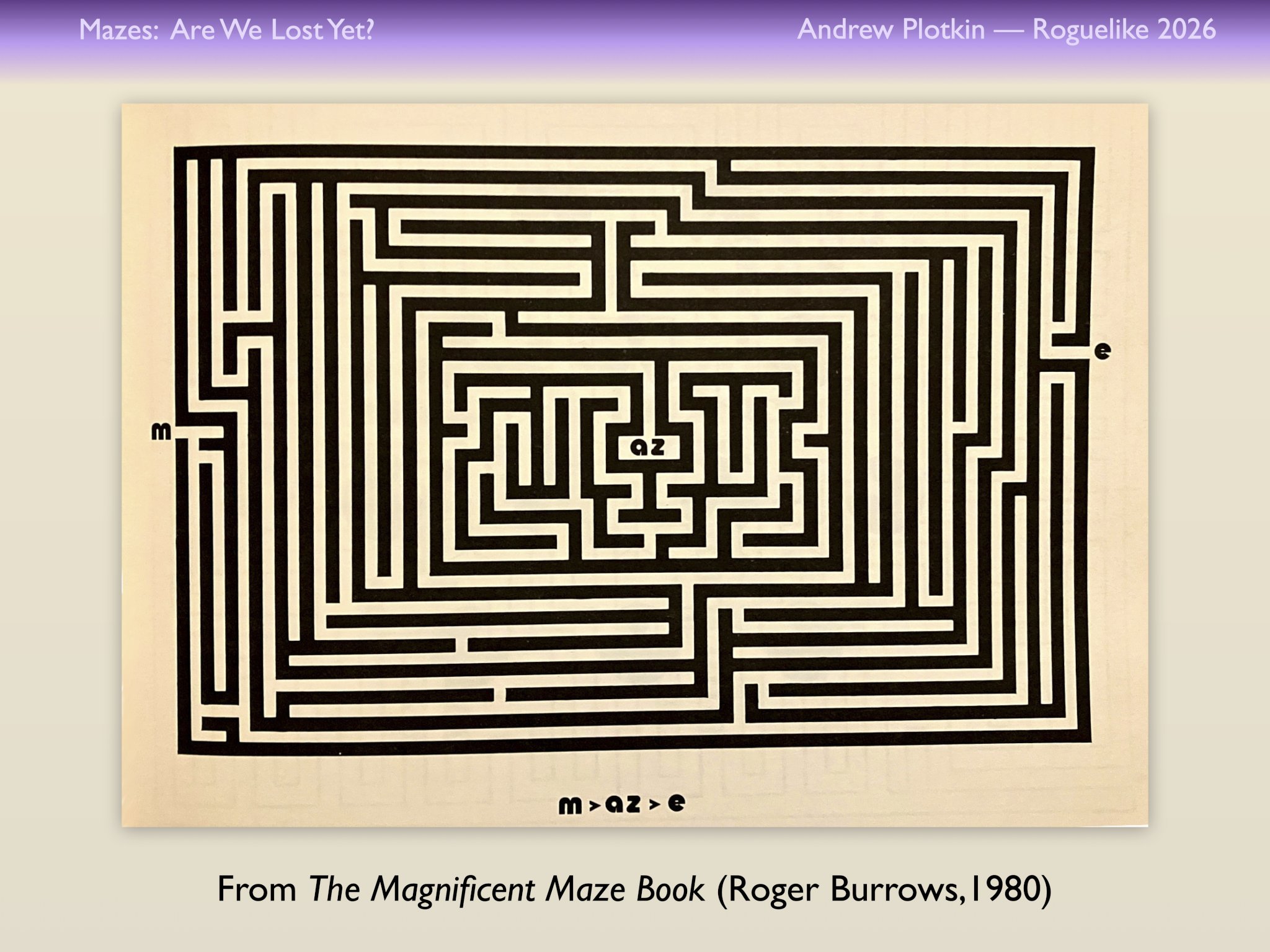
Everybody knows what a maze is, right? Here’s a maze:
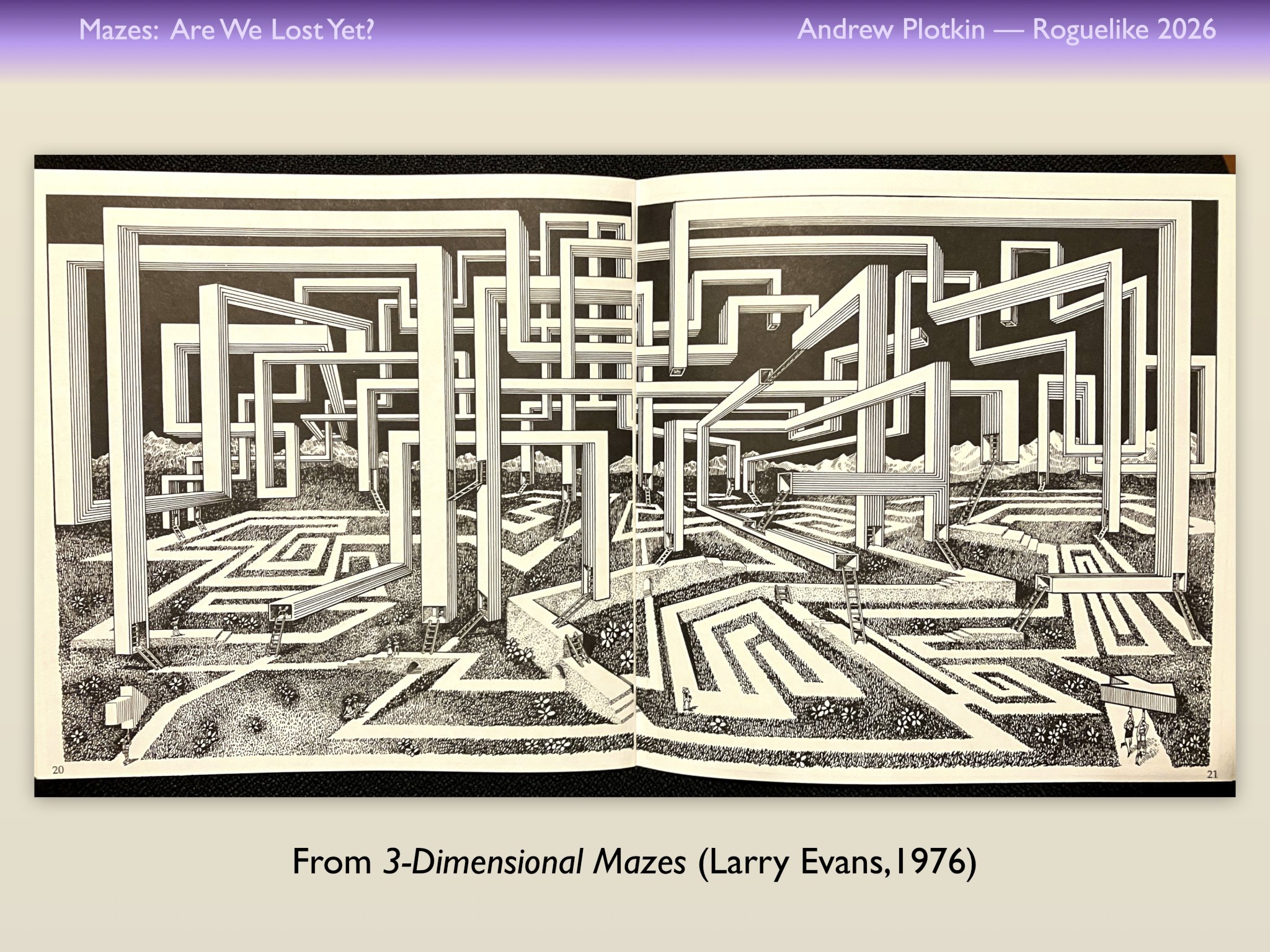
Larry Evans was a maze designer in the 1970s. I love this guy. Really, this talk is mostly just an excuse to show off some of his books from my collection.
Anybody want to say that’s not a maze? Don’t answer that. We’re going to say this is a maze.
Approximately 45 seconds after videogames were invented, somebody said “Let’s put a maze in a videogame!”
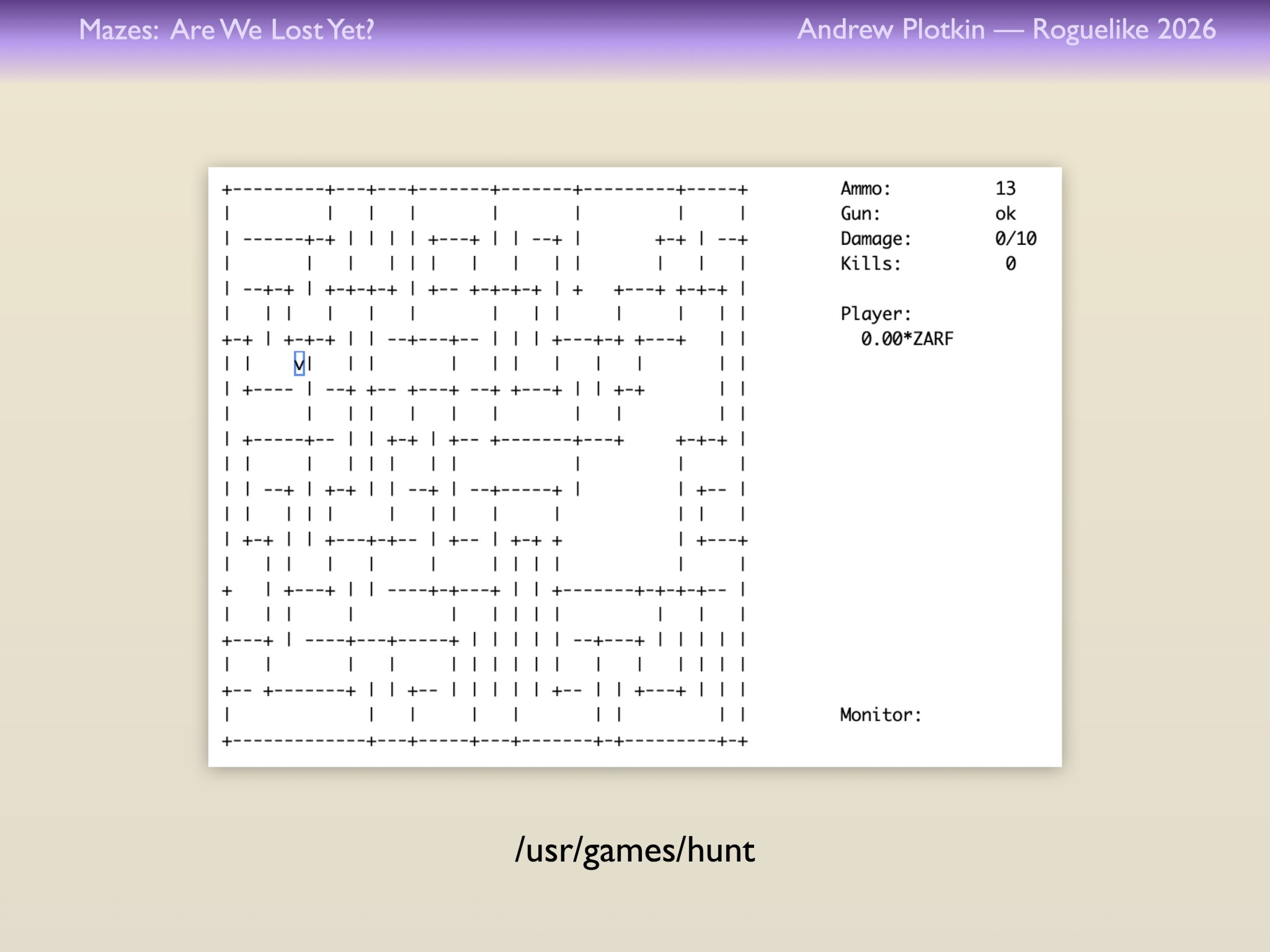
This is a classic Unix game called Hunt. It’s a multiplayer tag game – in a maze!
This maze is randomly generated. There are simple algorithms to generate this sort of grid maze. (I’m not going to get into the details, because this isn’t an algorithm talk, but there’s lots of resources on maze algorithms.) It’s not an artistic maze, like the previous slide, but the algorithm guarantees that the maze is solvable: there’s a path from any point to any other point.
Of course, this sort of maze is perfect for roguelikes:
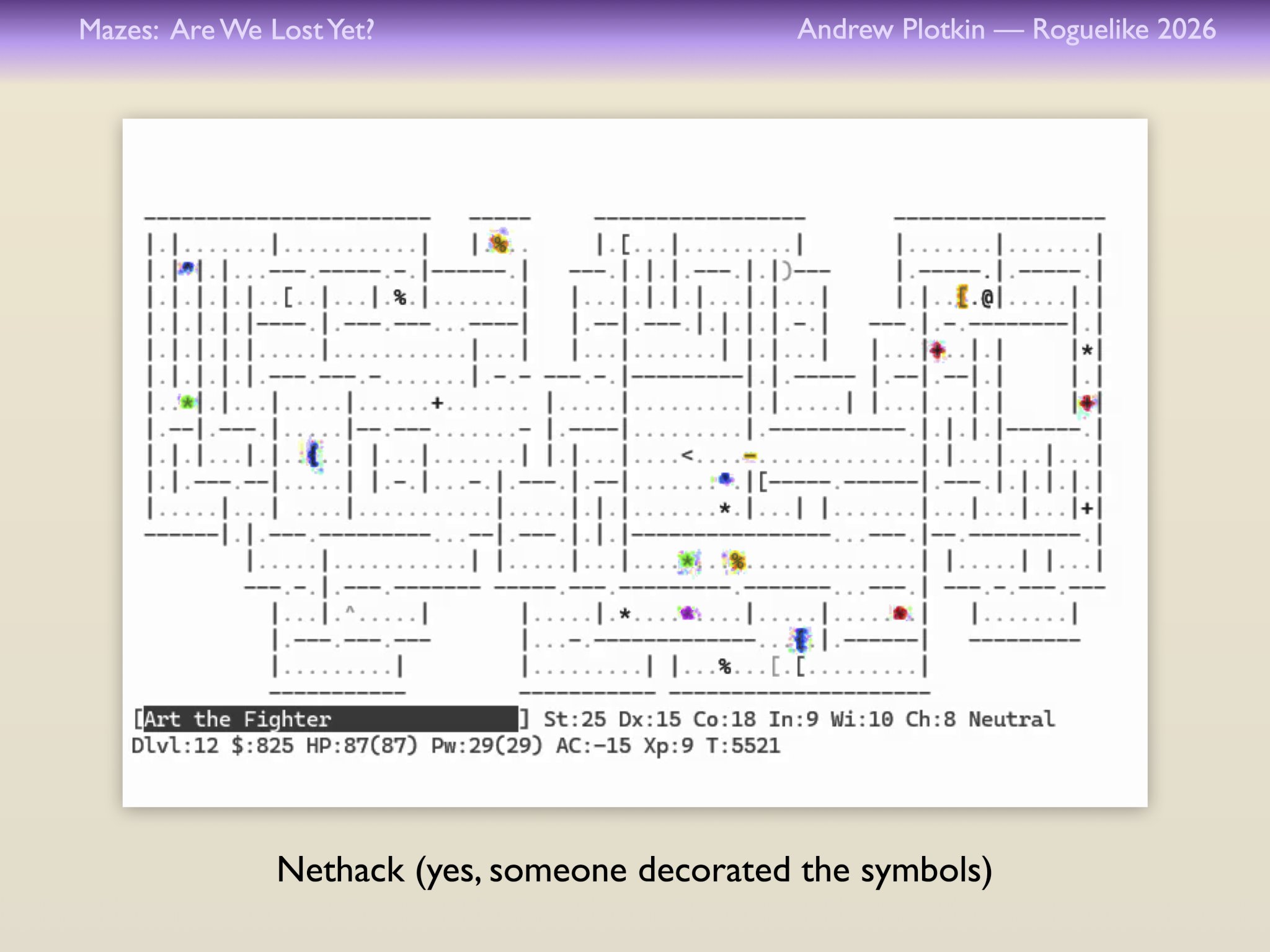
These are the Gnomish Mines from Nethack. It’s the same kind of maze.
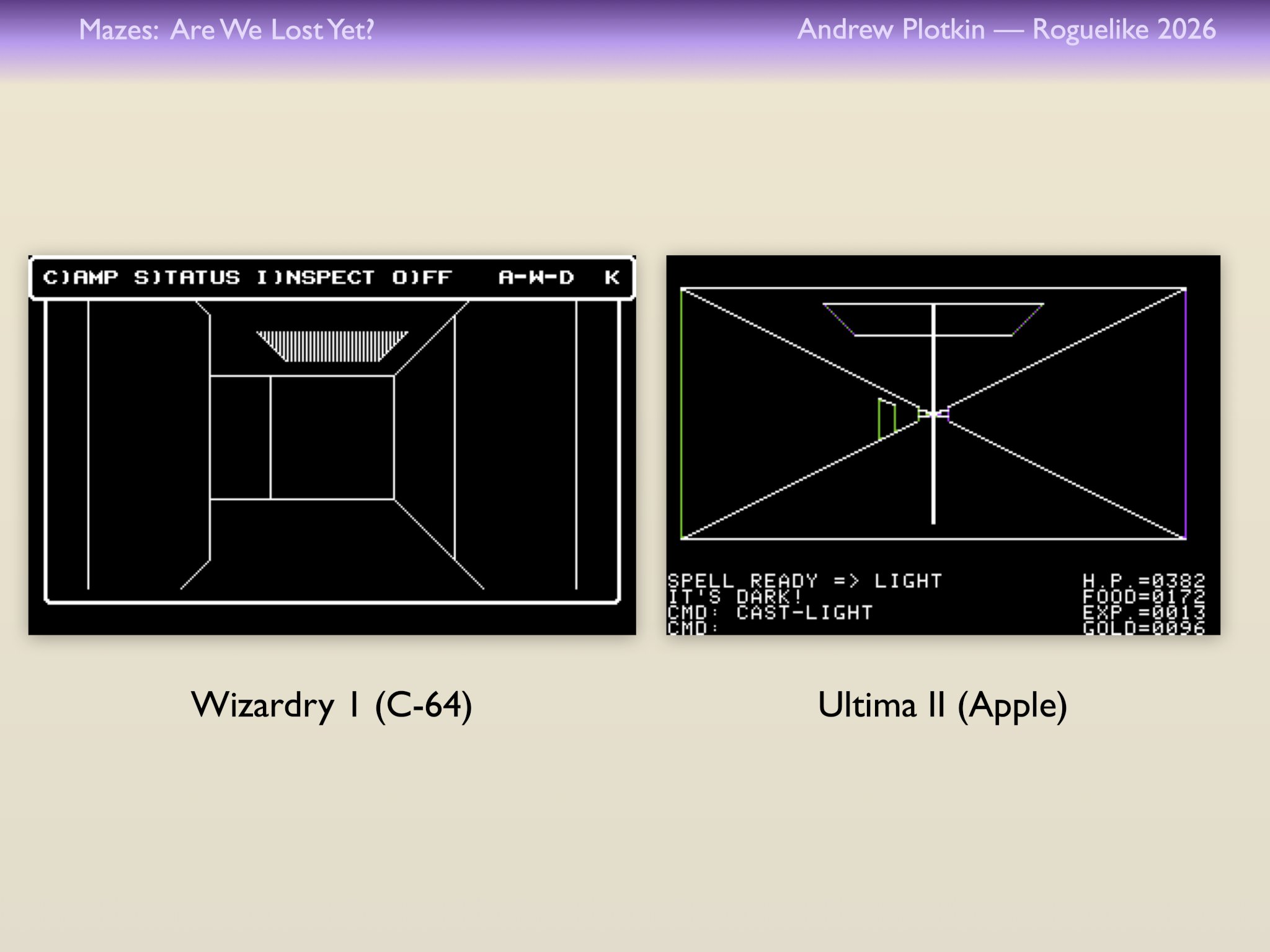
Here’s another couple of videogame mazes. They don’t look anything like the previous examples, but we understand that they are the same thing. When you run around in them, you are solving the maze. Or finding your way through the maze, anyhow. It’s the same experience.
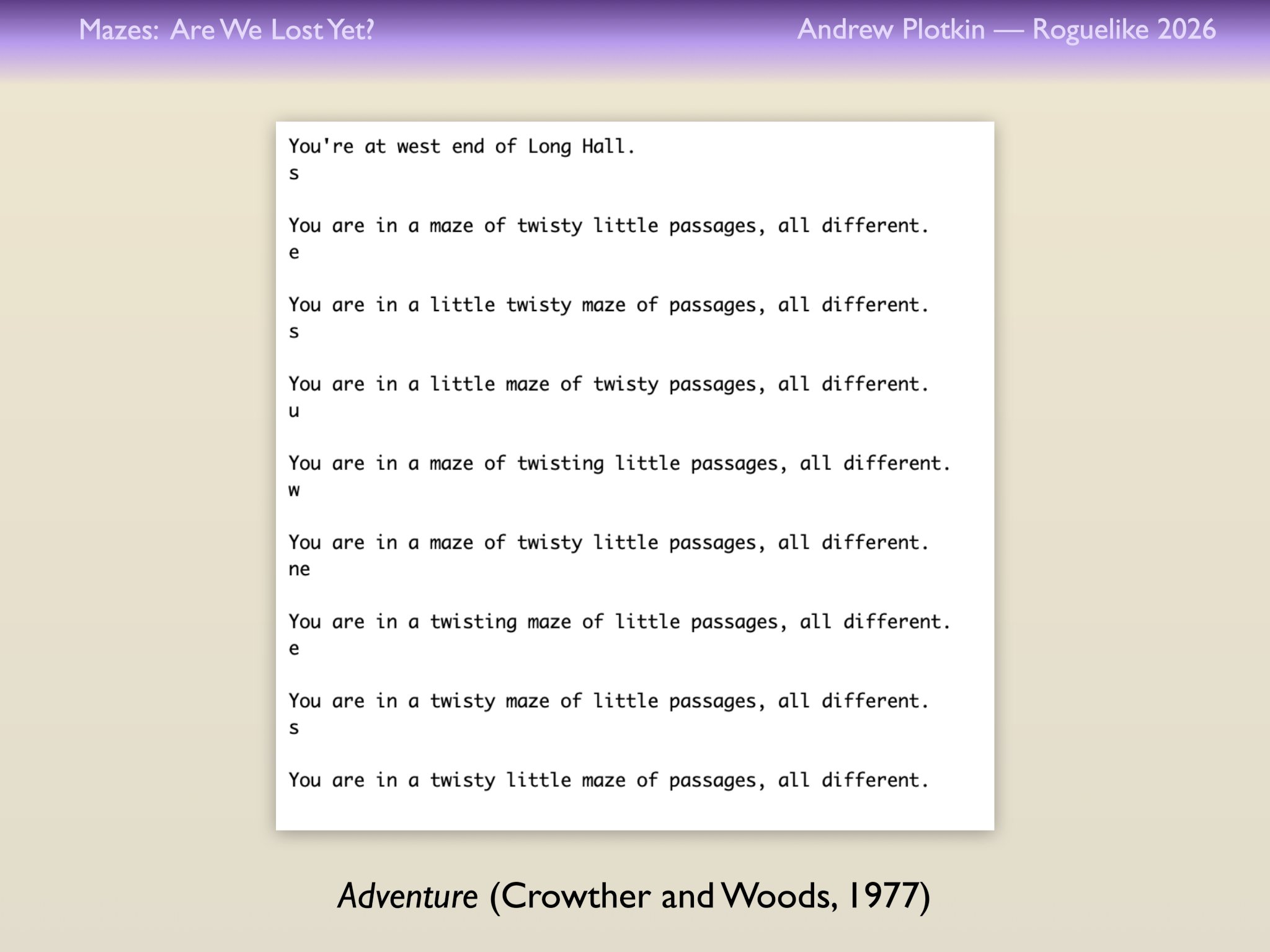
And here’s another videogame maze which is different from all of the previous examples.
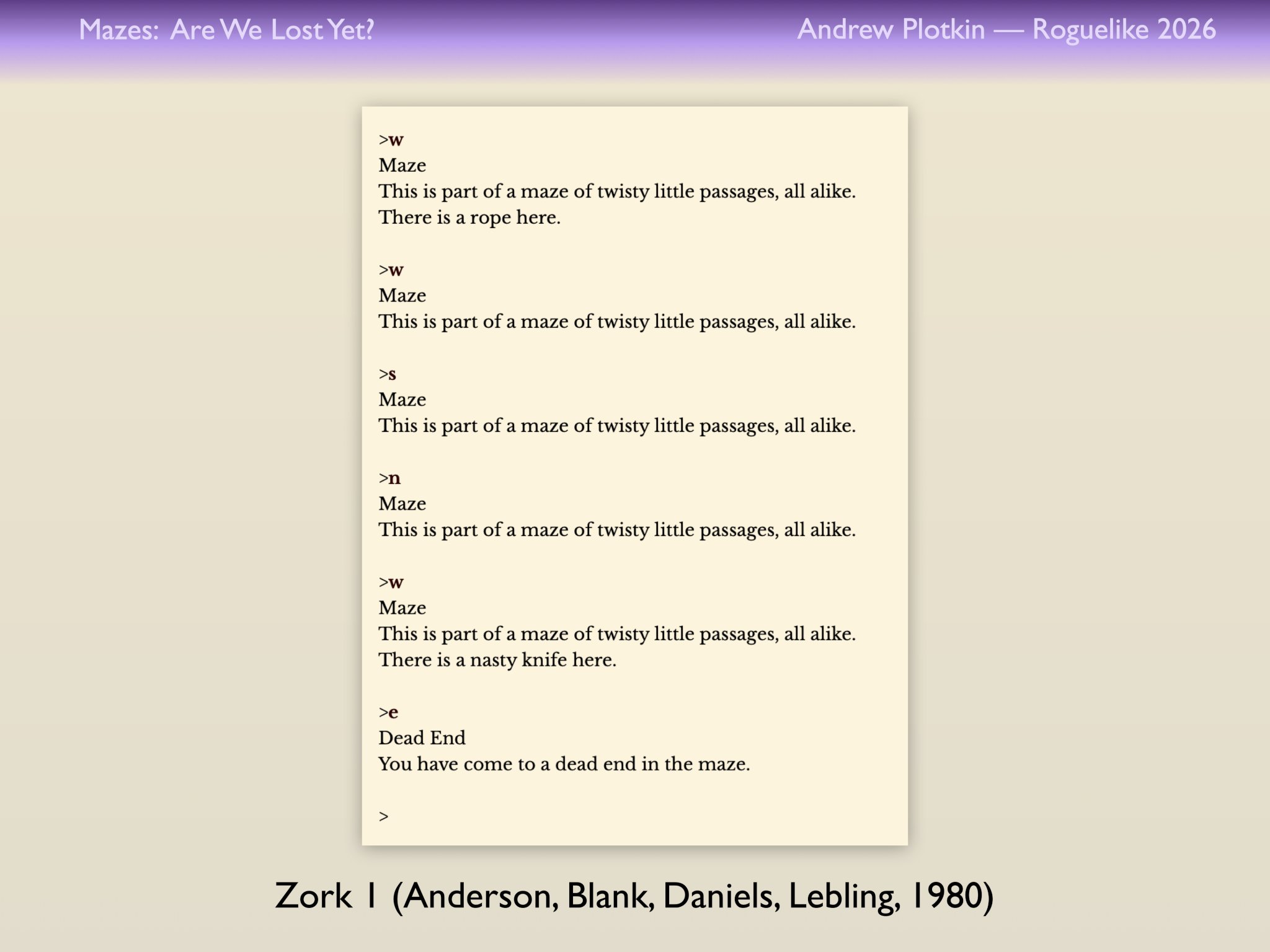
Another text adventure game. It’s plain text, but it’s still a maze on the screen. Right? It says “Maze” right there. And you can get lost in it.
Okay. I’ve just thrown three completely different game models at you, and I called them all mazes. Four if you include the printed paper maze. Am I playing fast and loose with definitions? Who says they’re all the same thing? What do they have in common?
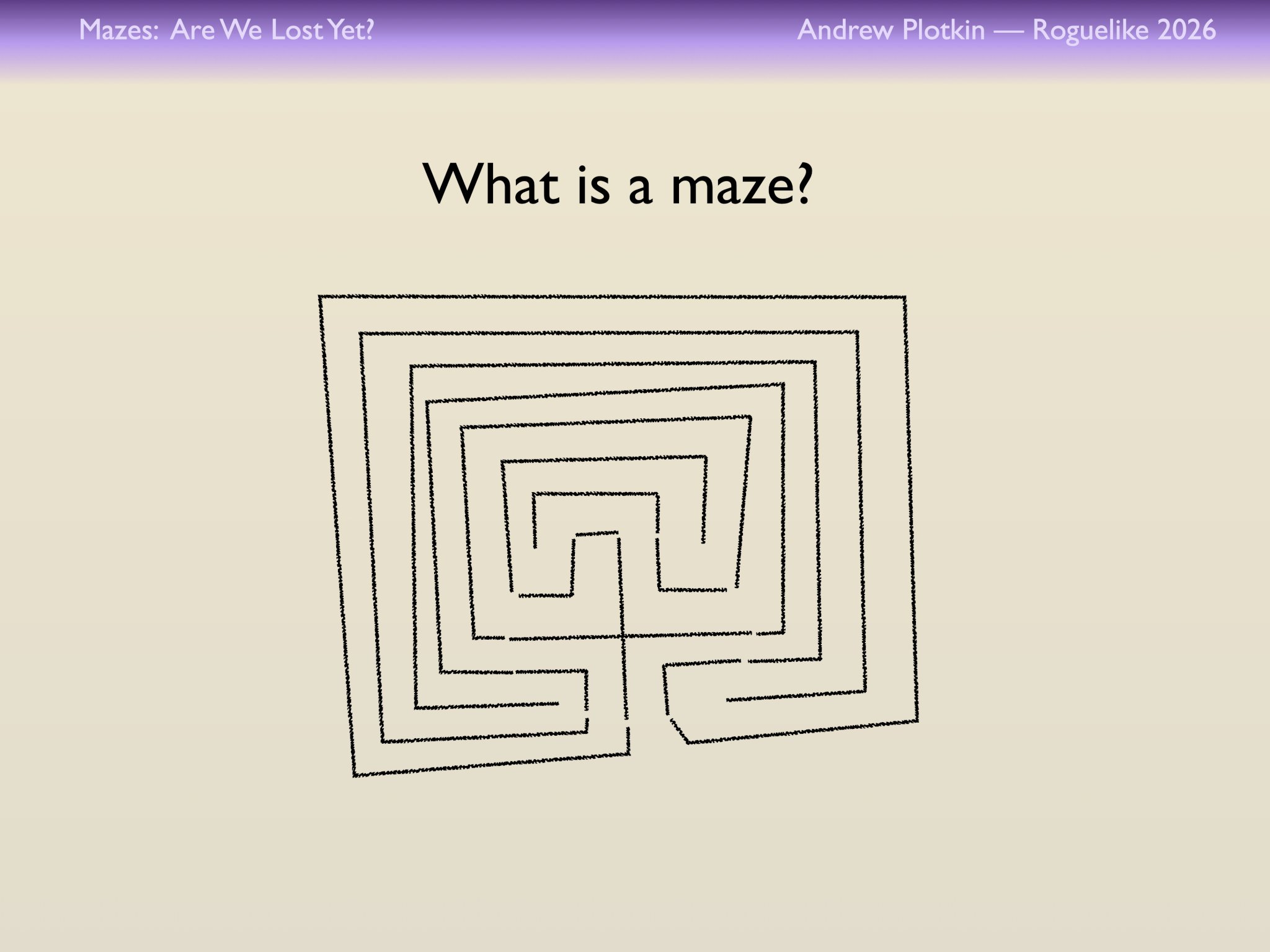
Let me try to write down some definitions.
When you’re playing Ultima or Wizardry, you draw maps.
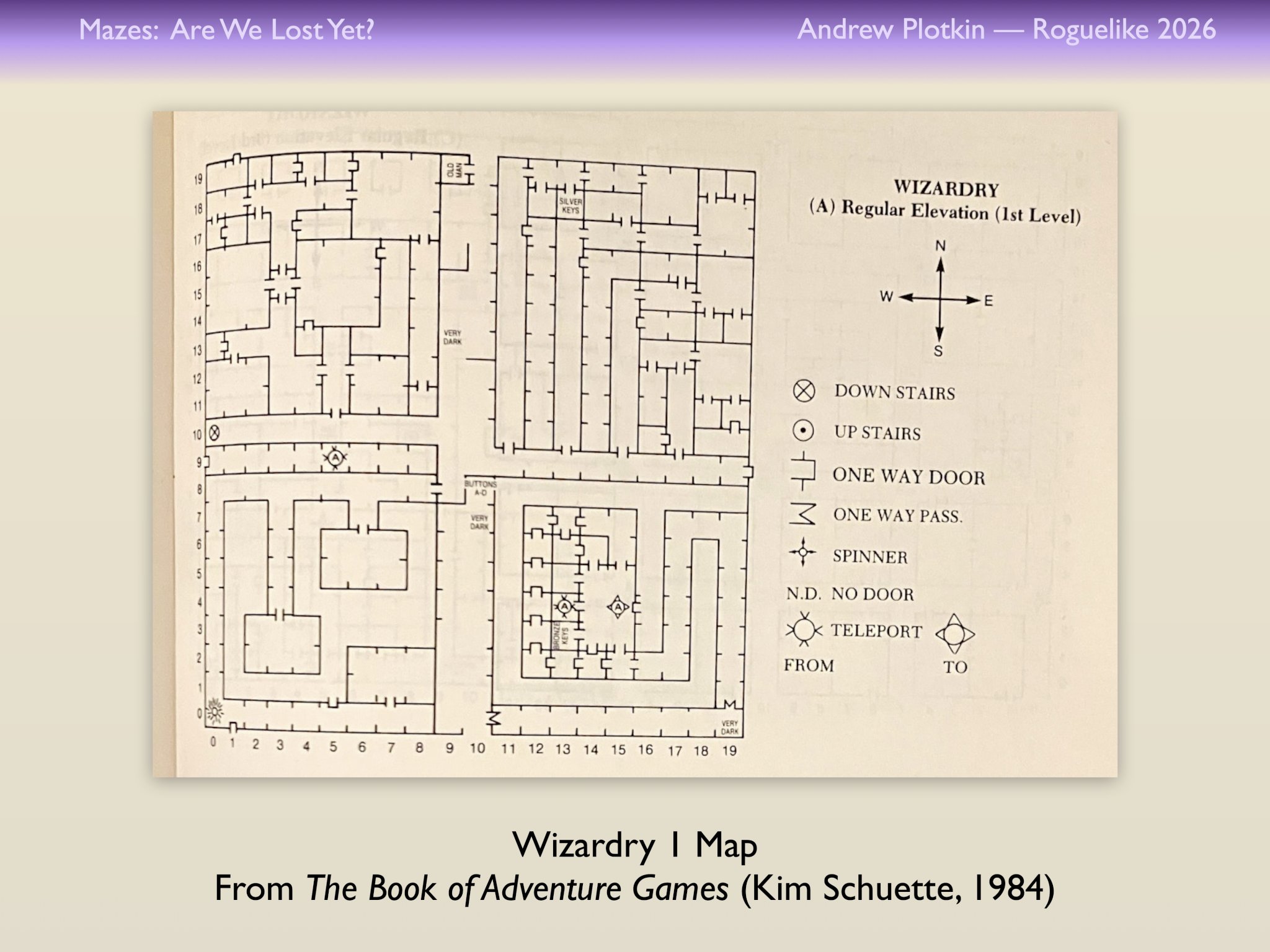
Here’s Wizardry again. This page is from a guide book, but if you played the game when it first came out, you drew this map yourself. Then you’ve drawn a maze, just like those classical top-down-view printed maze.
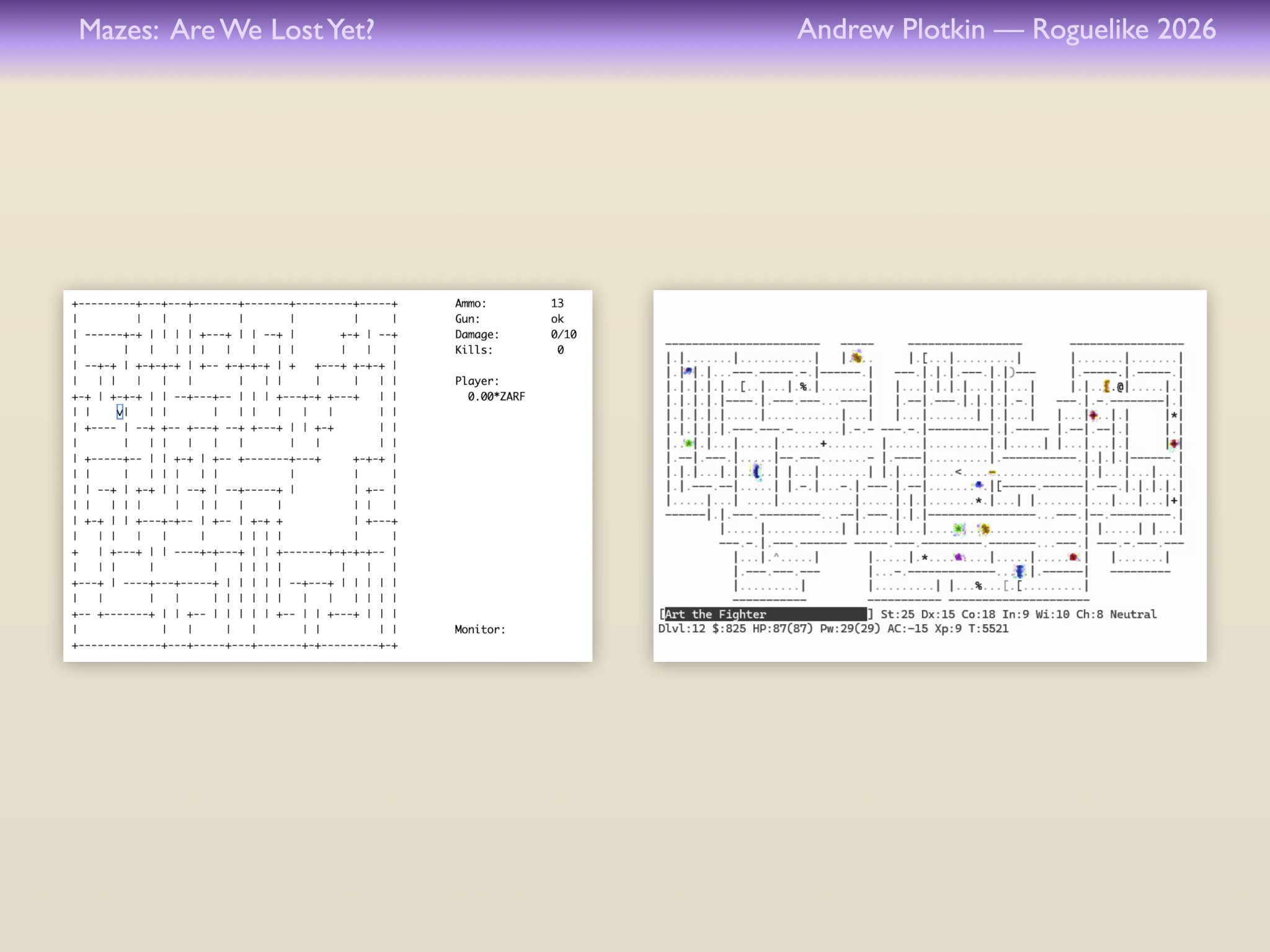
Playing these maze games also involves drawing maps. You don’t draw the map yourself; the game draws it for you as you explore the maze. Both of these games start out with blank screens and then fill themselves in progressively. If you look you can see that both of these screenshots are incomplete.
And of course you draw maps in text adventures.
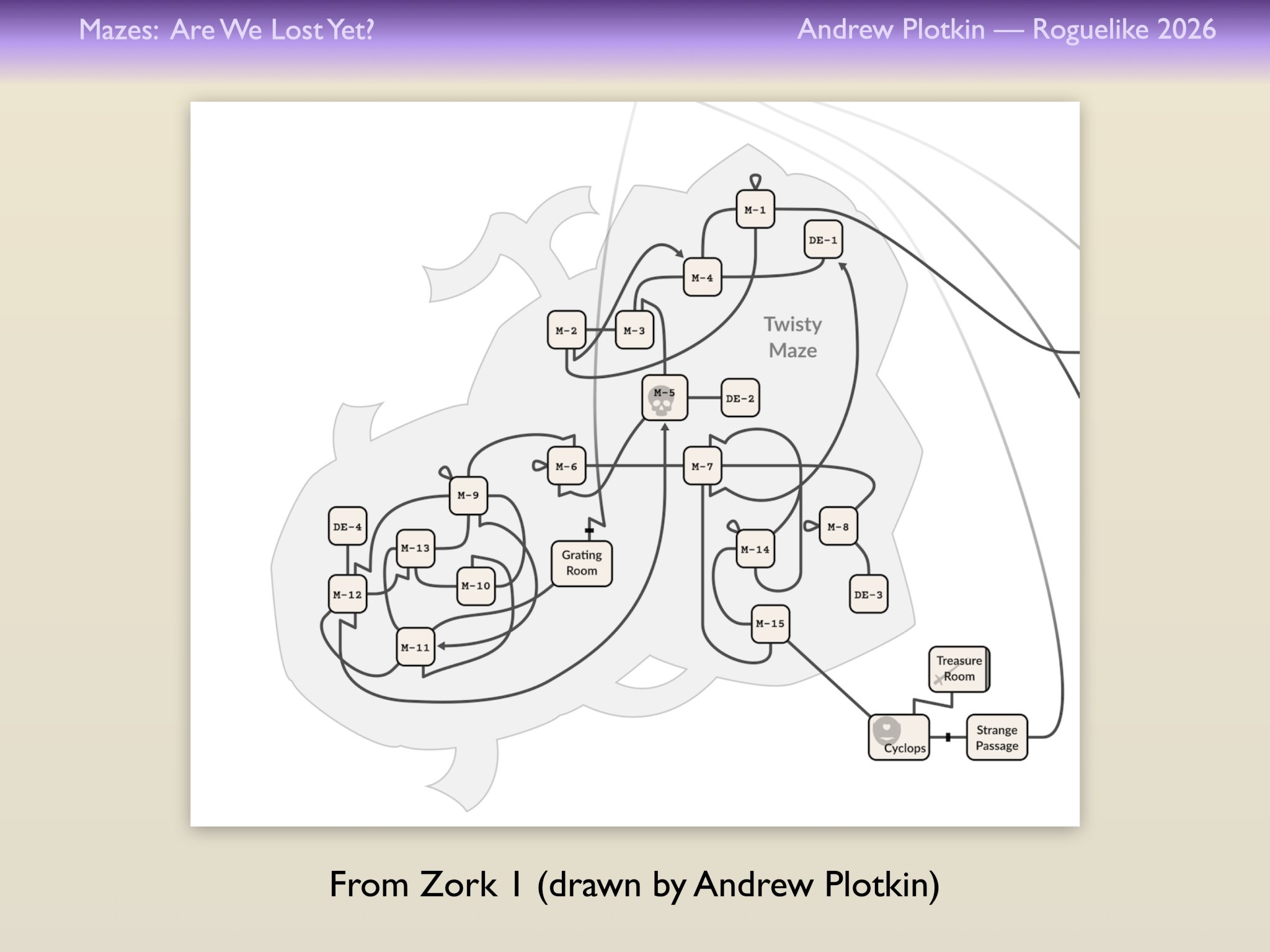
This is the maze from Zork 1. It doesn’t really look like the Wizardry map, or the classical paper maze. But it’s a map; you can use this to get around the maze.
So maybe we should say that a maze is any space that you have to map. But there’s a problem with that definition.
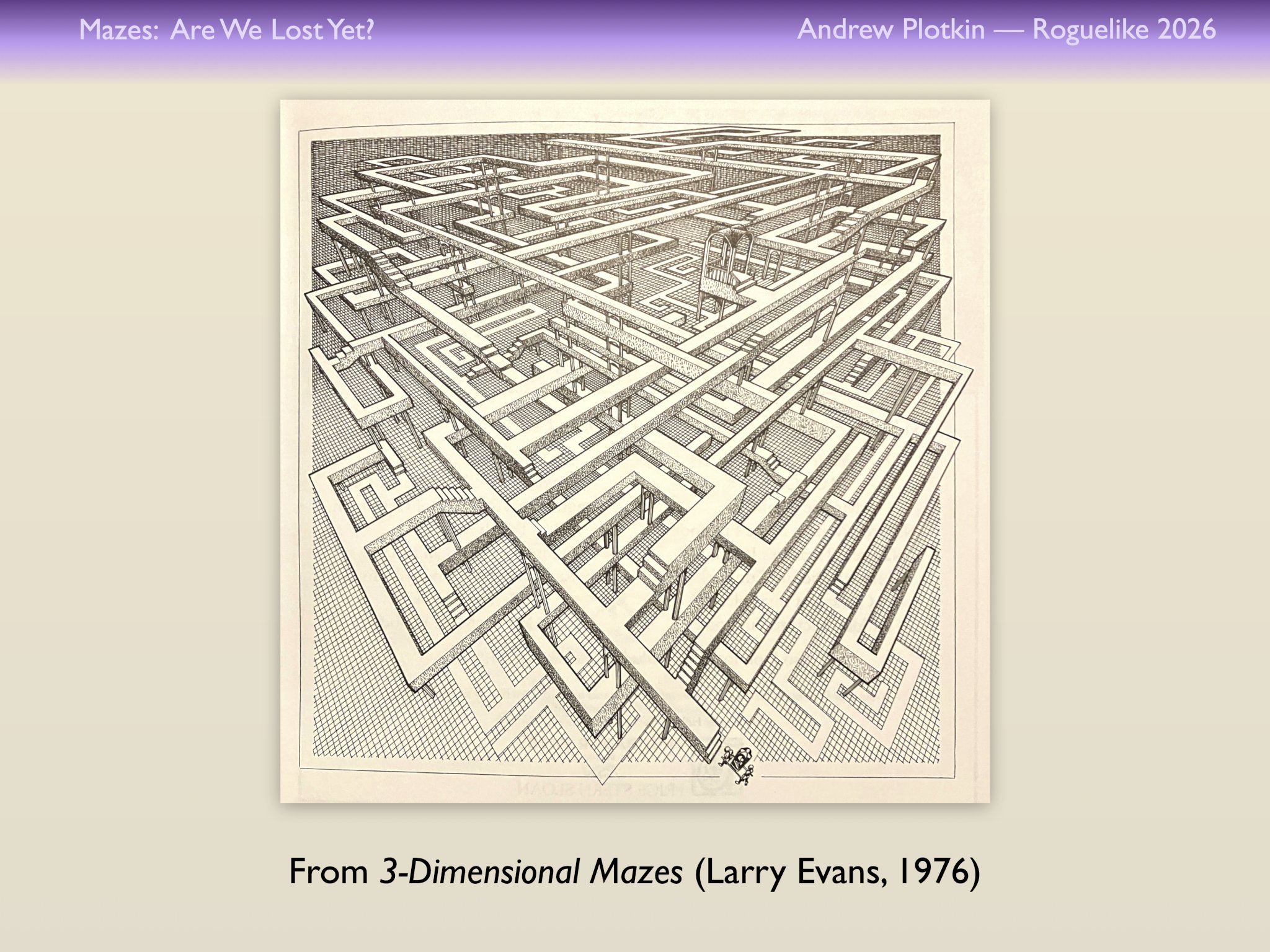
(Seriously, I love this guy.)
If you go back to that classic artistic paper maze, you don’t have to draw a map to solve it. The page you see here is a map. That’s what the artist gives you. Then you have to solve the maze. So clearly the act of solving must be distinct from the act of mapping.
Maybe it’s not you drawing the map that’s important. Maybe it’s just important that there is a maze map. The arrangement of the game is, or is equivalent to, or represents, a maze-style layout.
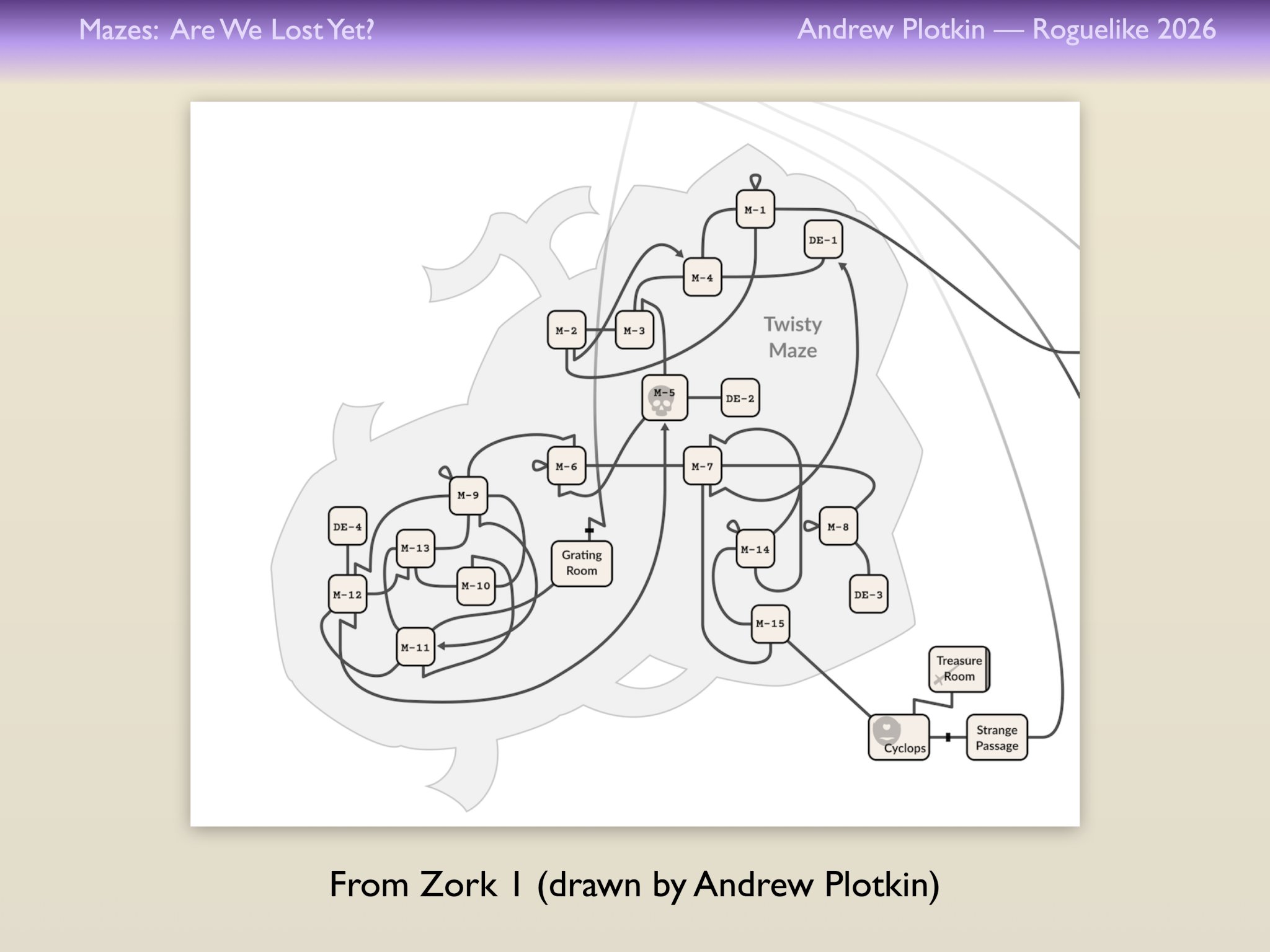
Except Zork breaks the pattern again. This isn’t a two-dimensional maze, or even a three-dimensional maze. It’s just a hairball. The game represents a complicated layout, but it doesn’t have the style of a classical maze. It’s just an abstract graph of nodes and connections.
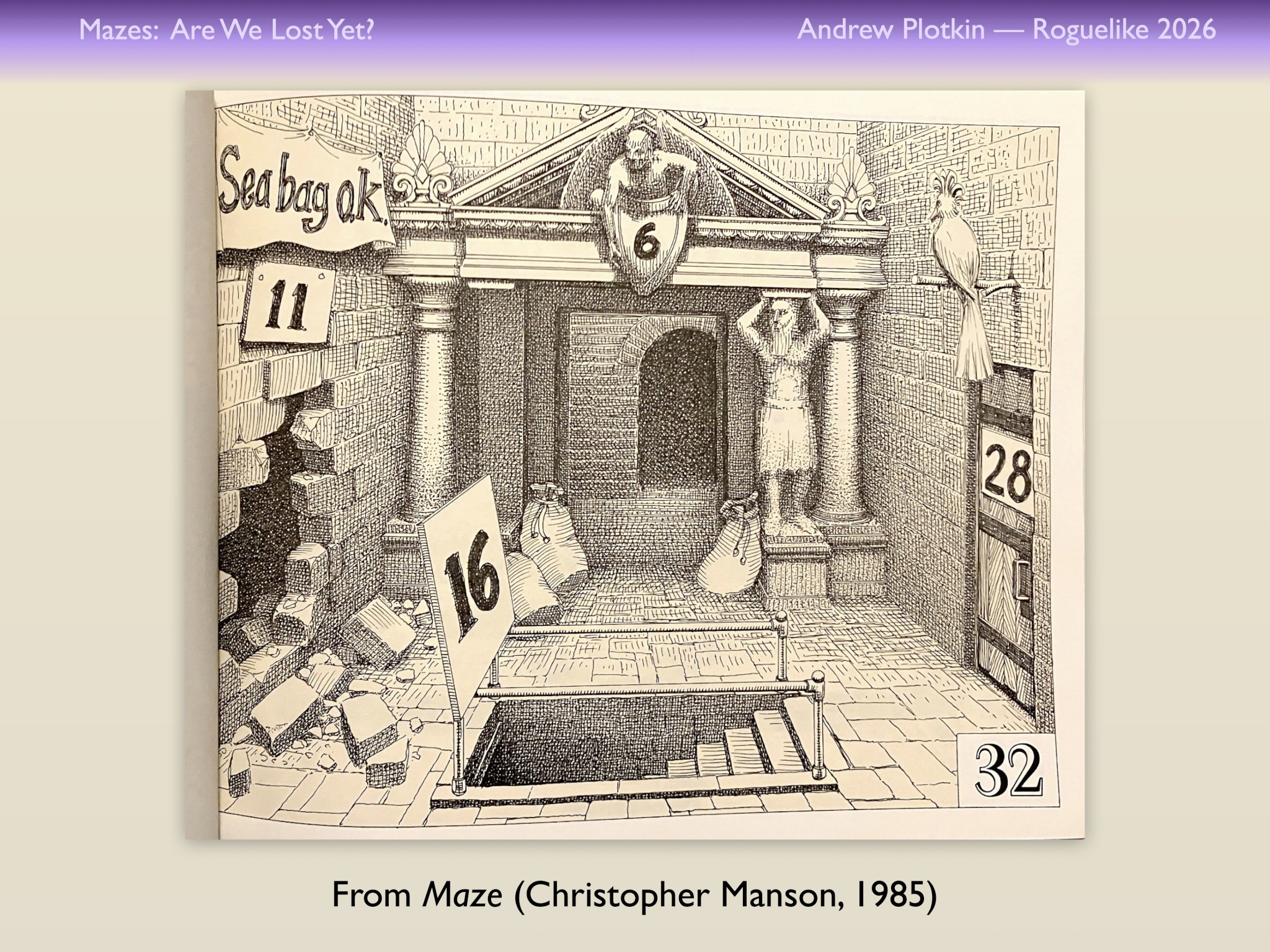
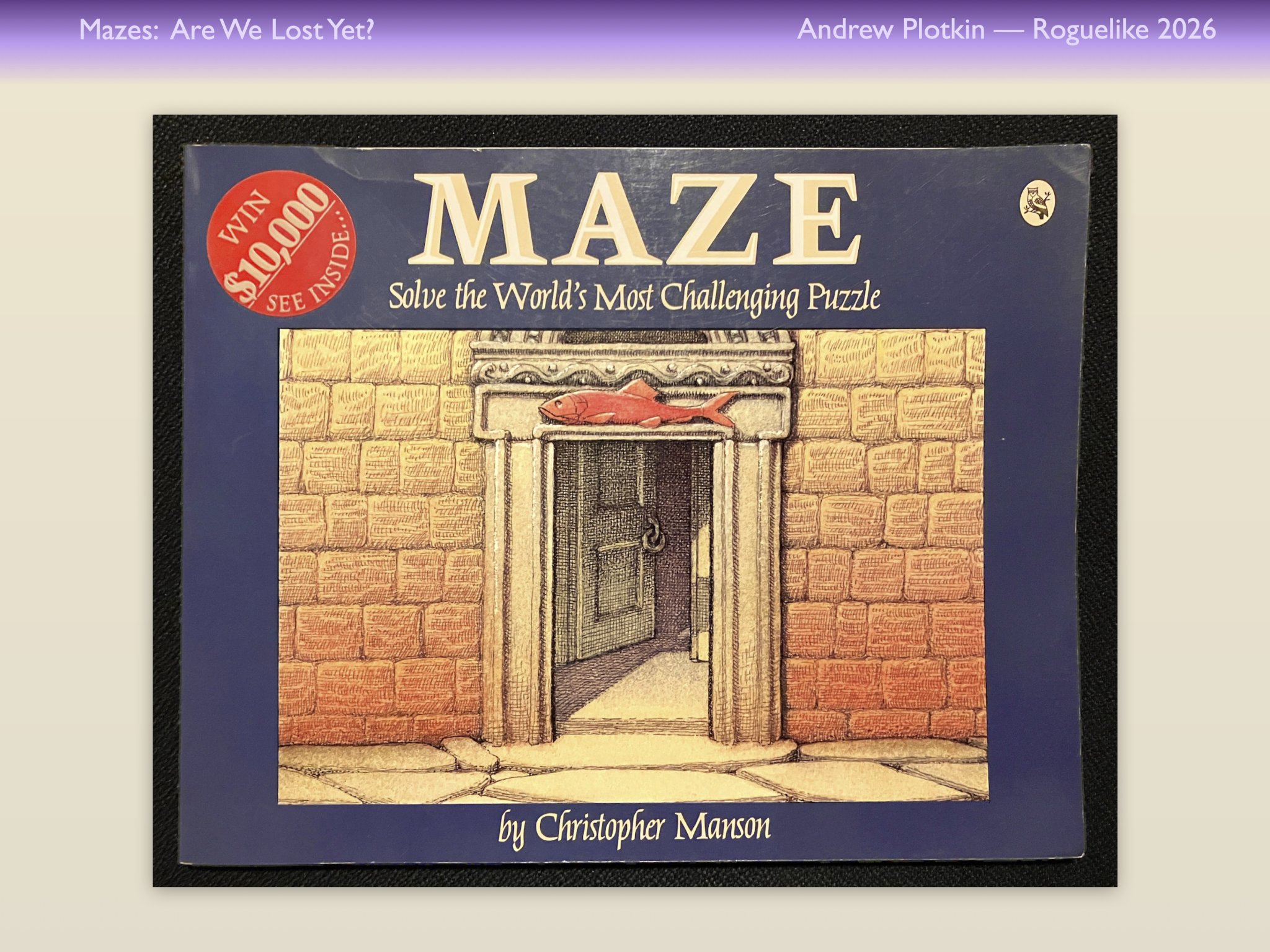
That’s not just because Zork is a text game. This is a page from the book Maze. If you’ve played Blue Prince you might recognize this book. It’s not a videogame, but it’s sort of a choose-your-own-adventure maze book. The doors are numbered; the pages are numbered; each door leads to a different page. So it’s conceptually similar to Zork.
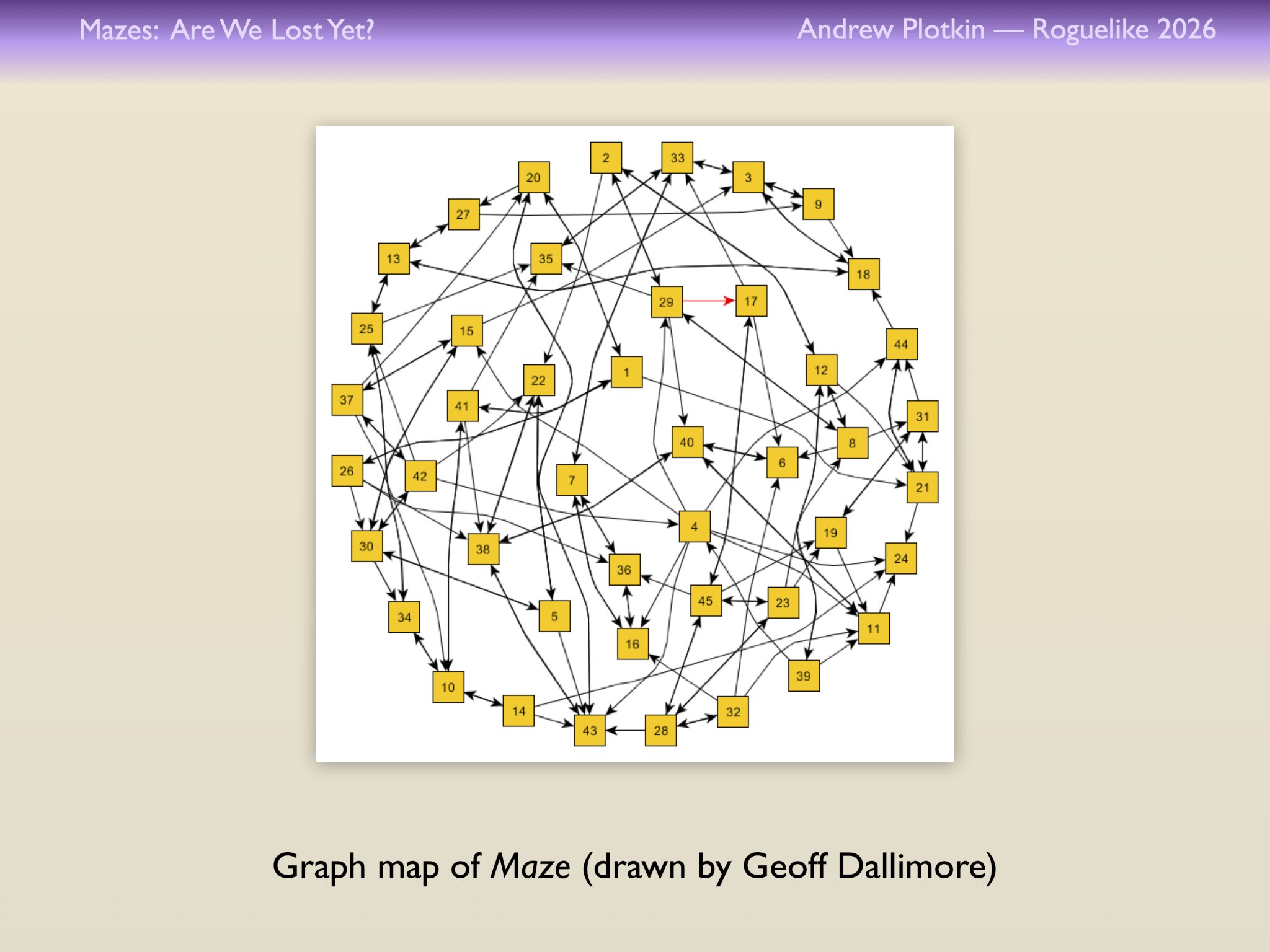
You can draw the Maze book as a graph, if you like. Just like Zork, it’s a hairball, not a picture of a classical maze.
Allow me to go down a side alley. Every maze can be drawn as a graph. Is every graph a maze?
Really, any puzzle can be drawn as a graph. Every puzzle has a state diagram.
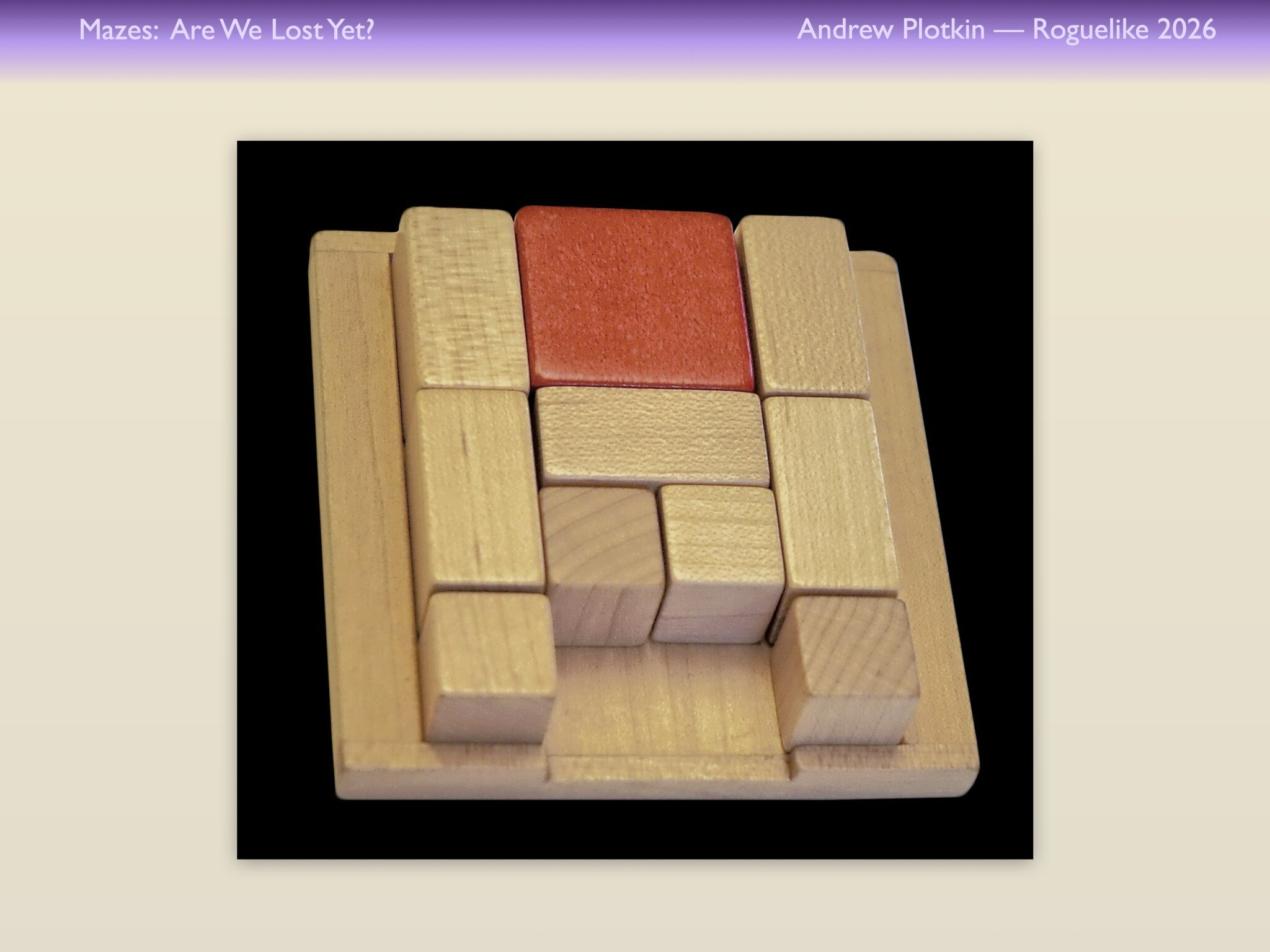
Here’s a slidey block puzzle. You can draw a graph of all the possible positions. I haven’t, because I hate slidey block puzzles, but you can imagine it. Does that make it a maze?
I’m going to say no, because it doesn’t feel like a maze to me. It’s abstract.
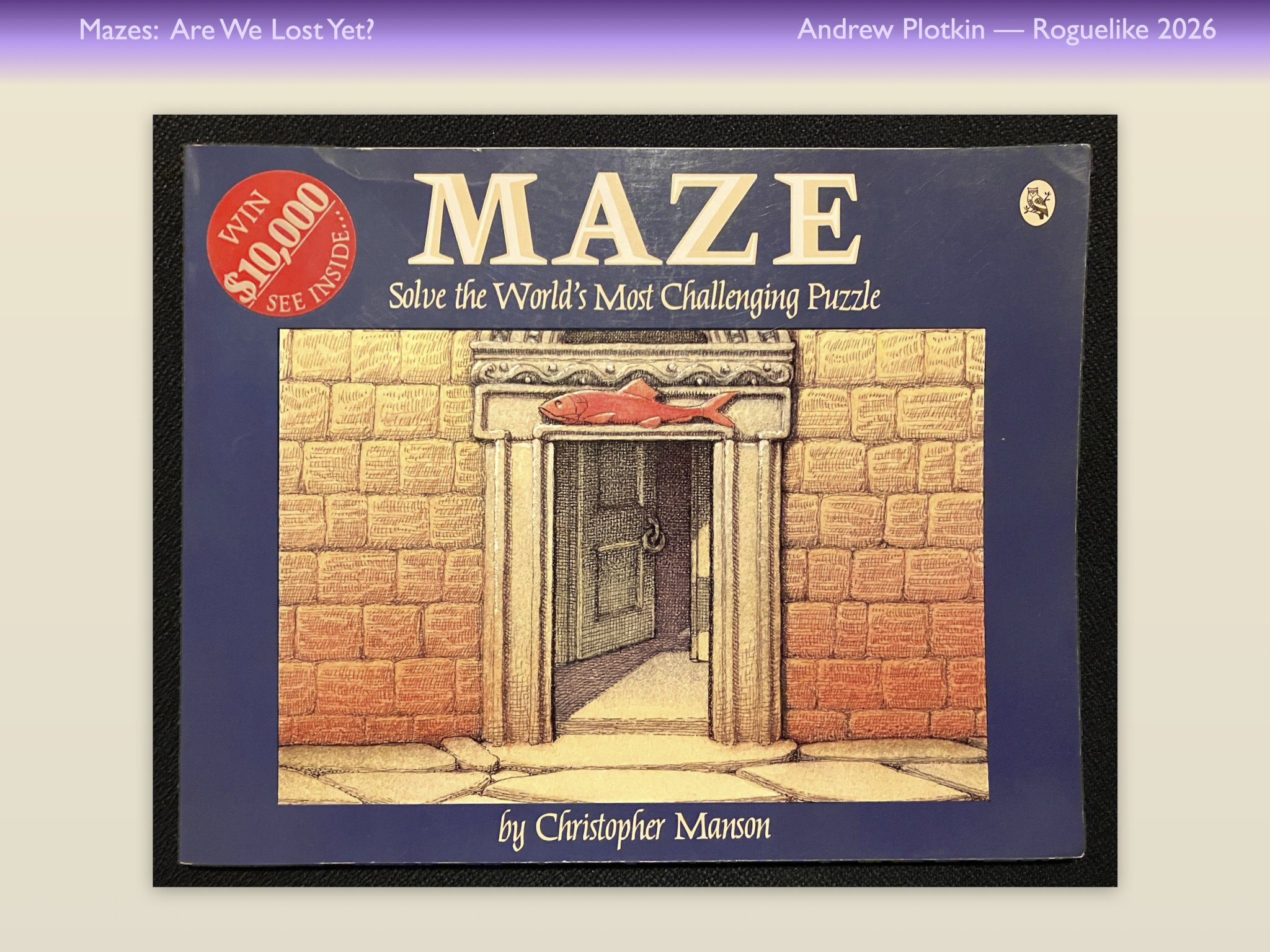
Whereas this isn’t abstract. It shows us a maze! It says it’s a maze right on the cover!
I guess that gives us another way to define mazes: anything that calls itself a maze?
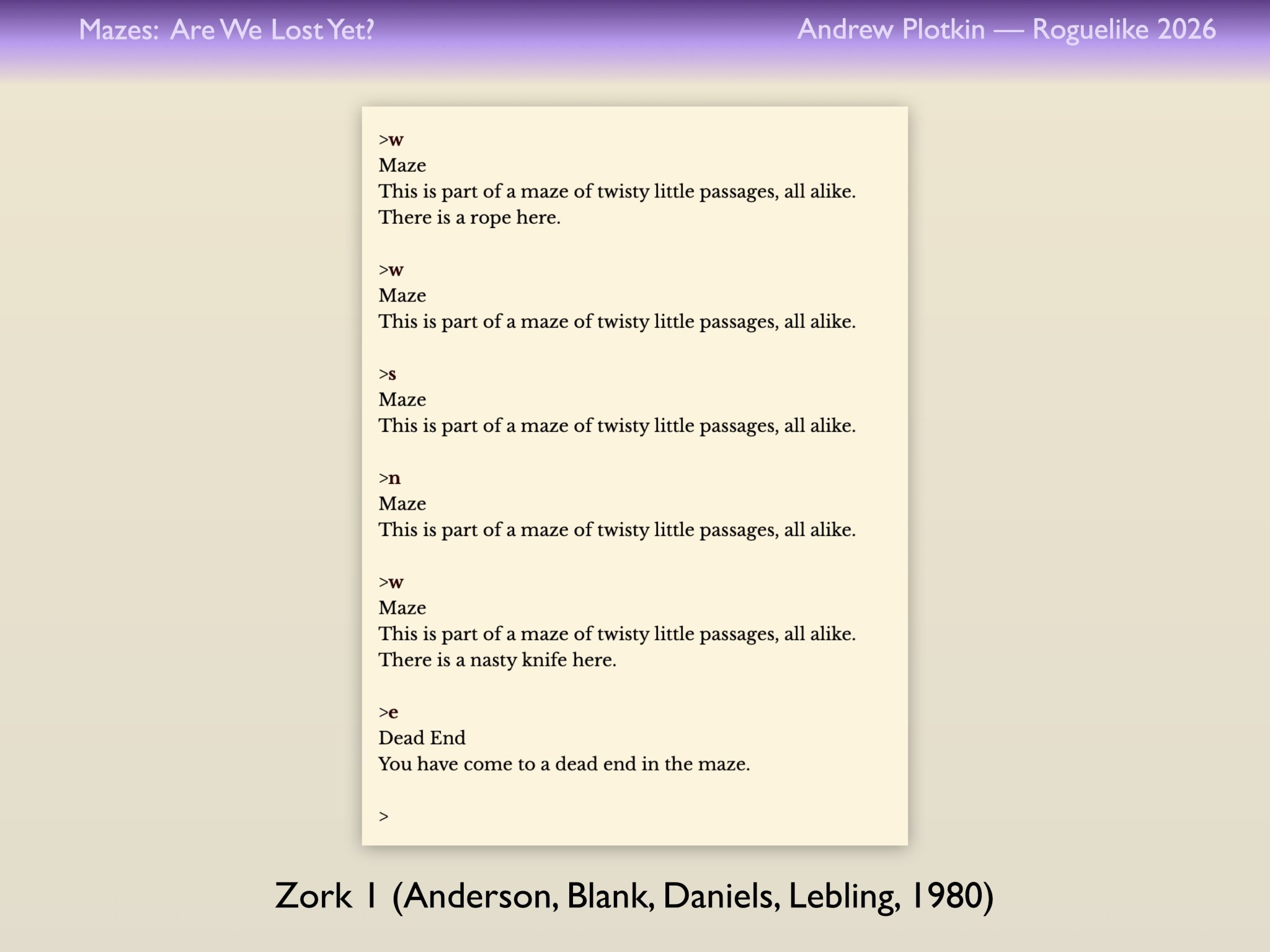
Zork does too.
We could use that as a definition, right? It’s a maze because the author calls it that and we agree.
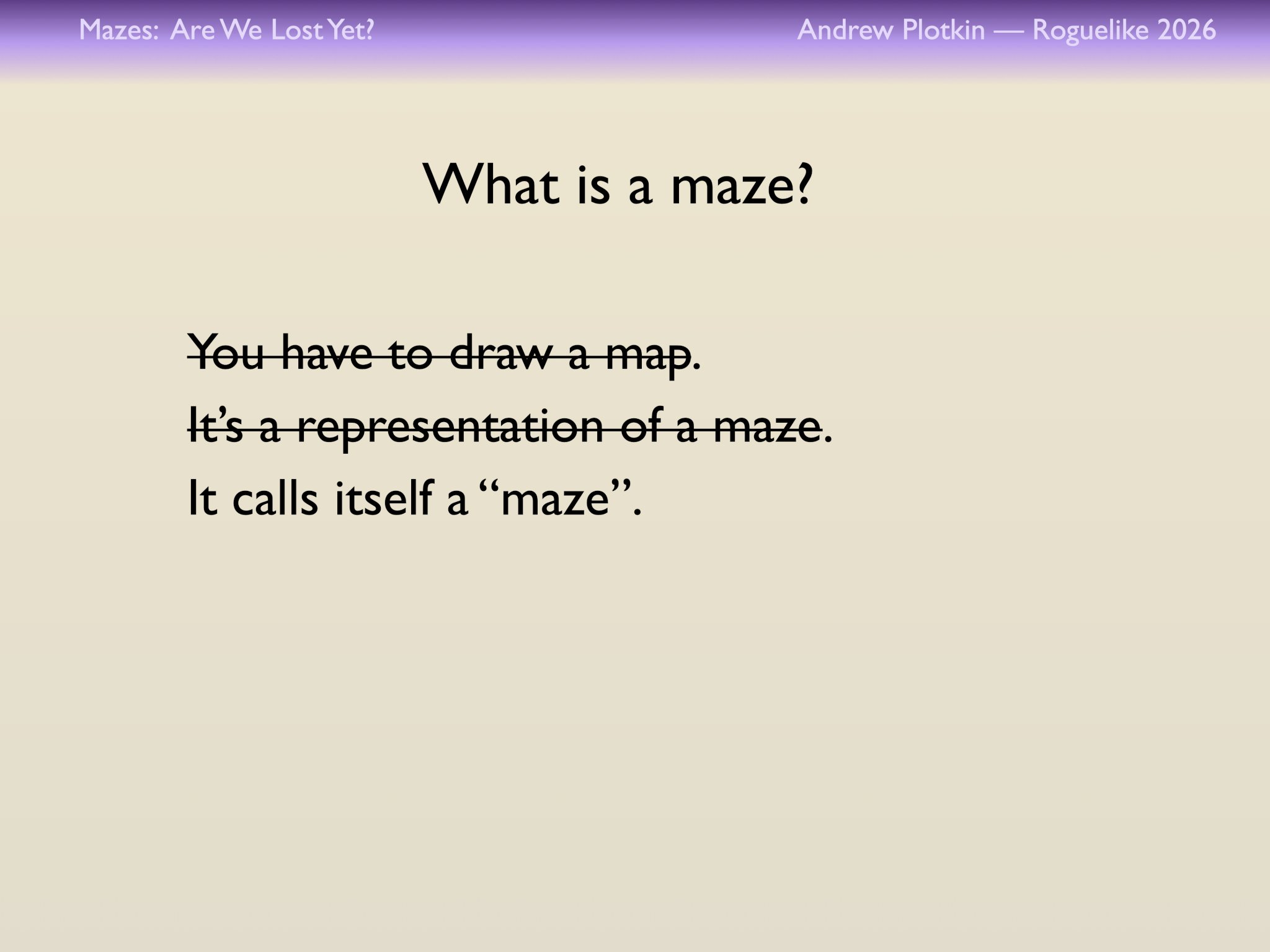
But that’s not very satisfying. Authors can lie. Puzzle authors enjoy lying. We’d be silly to rely on labels.
For that matter, Zork 1 actually has two mazes. The first one is called the “Maze”; the second one is called the “Coal Mine”. But they work the same way.
Let’s go with a more intuitive definition.
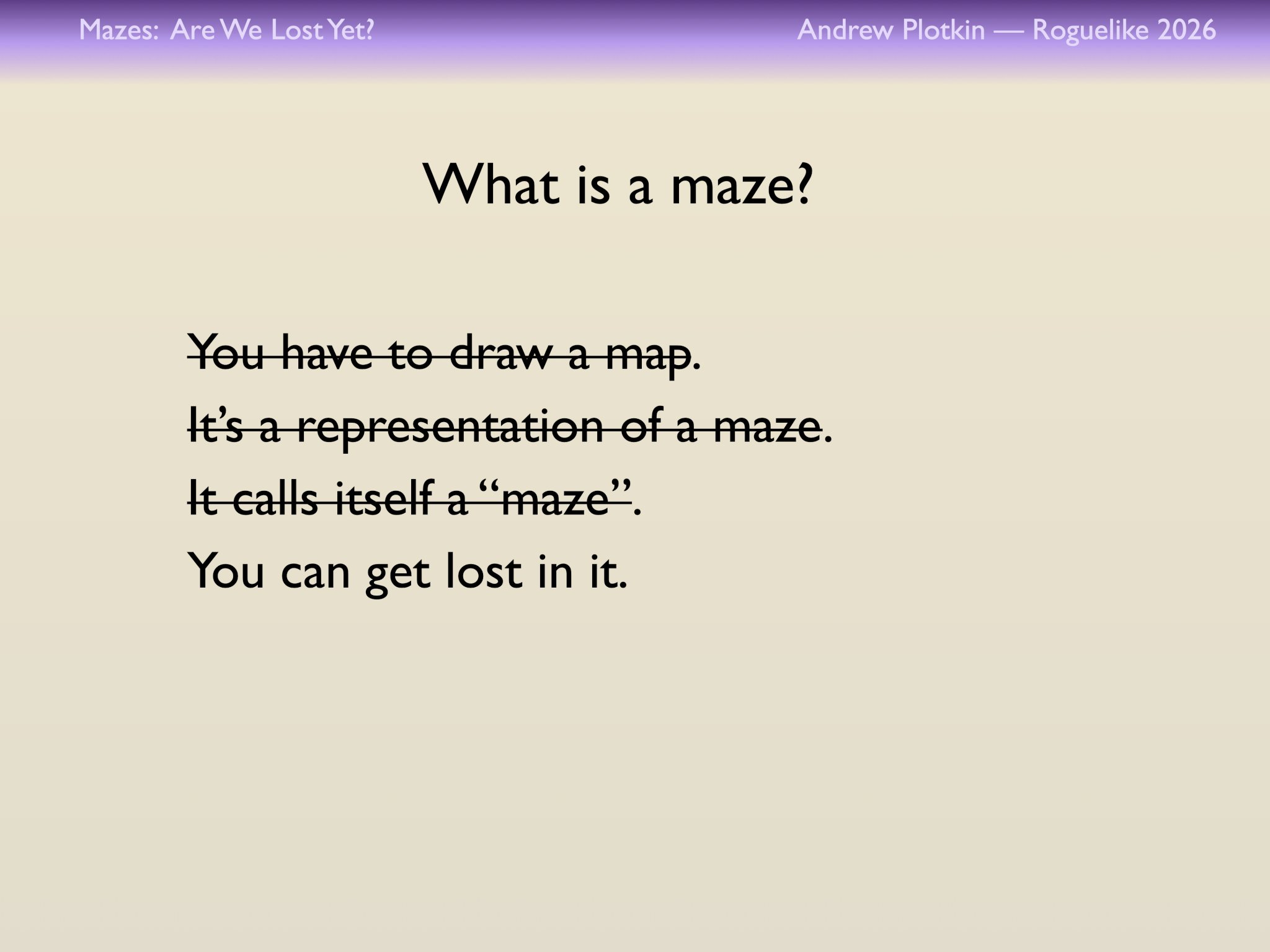
It’s a maze if you can get lost in it. This is what we’re trying to get at, right? A maze is tangled, it’s confusing, it gives us the experience of being lost.
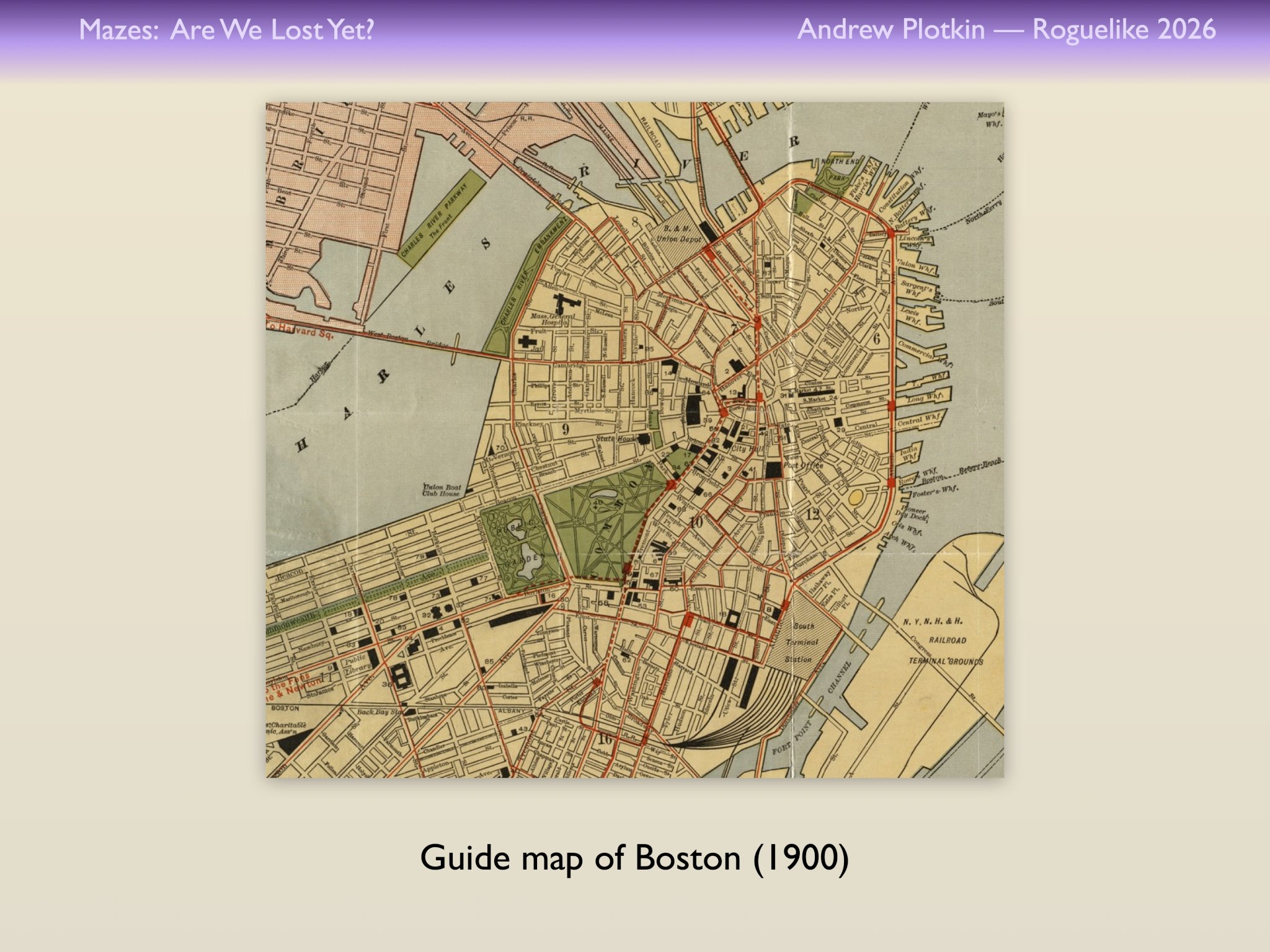
But there’s an obvious hole in that definition. People get lost all the time. At least, before smartphones they did.
I got lost in my doctor’s office a few weeks ago. That wasn’t a maze. I might metaphorically say “That building is a maze,” but that doesn’t make it one. If I put that medical building into a game, nobody would call it a maze. It would just be a slightly confusing level.
Really we want to see intention.
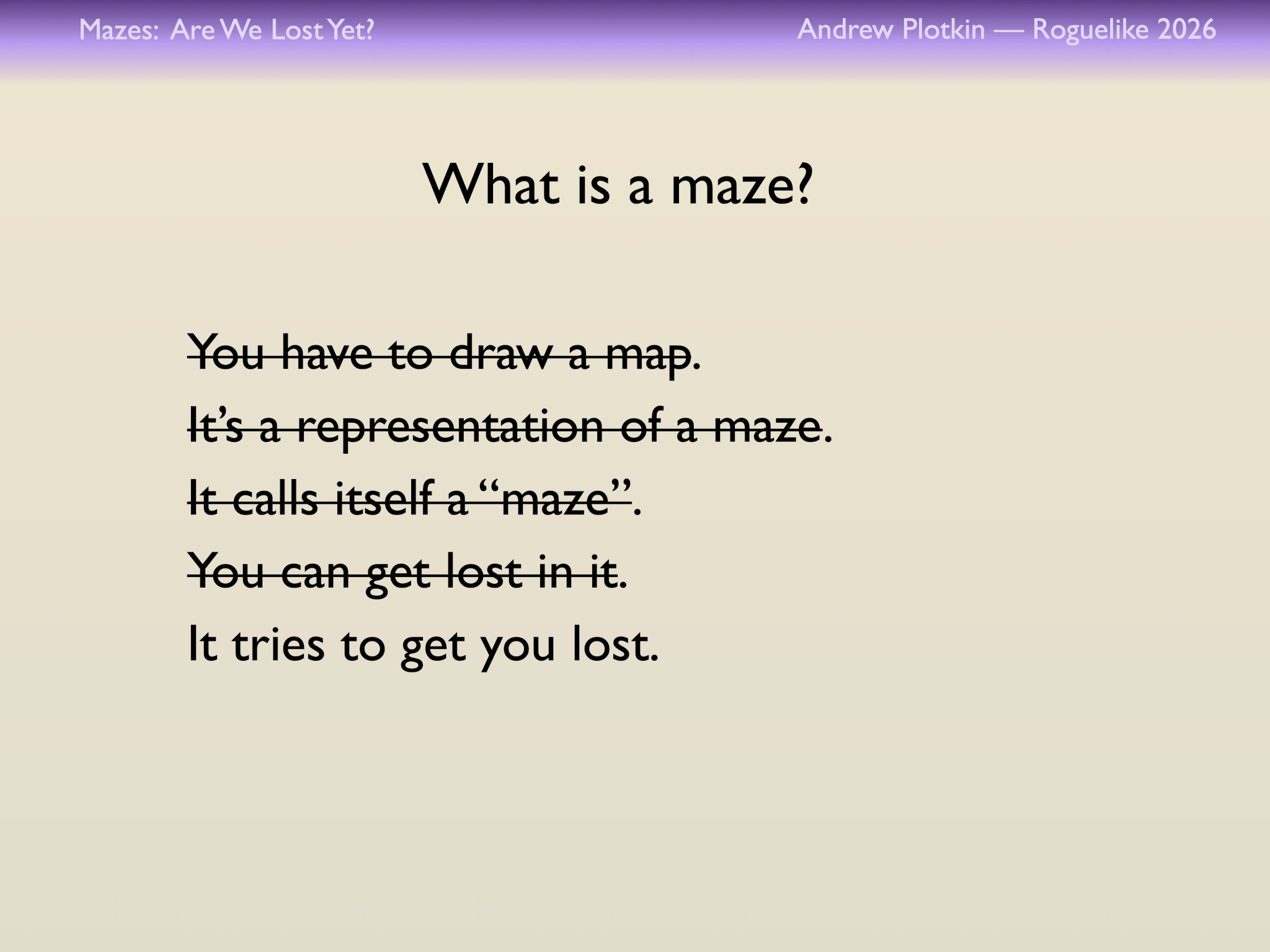
We want a map which gets you lost because it was designed to get you lost.
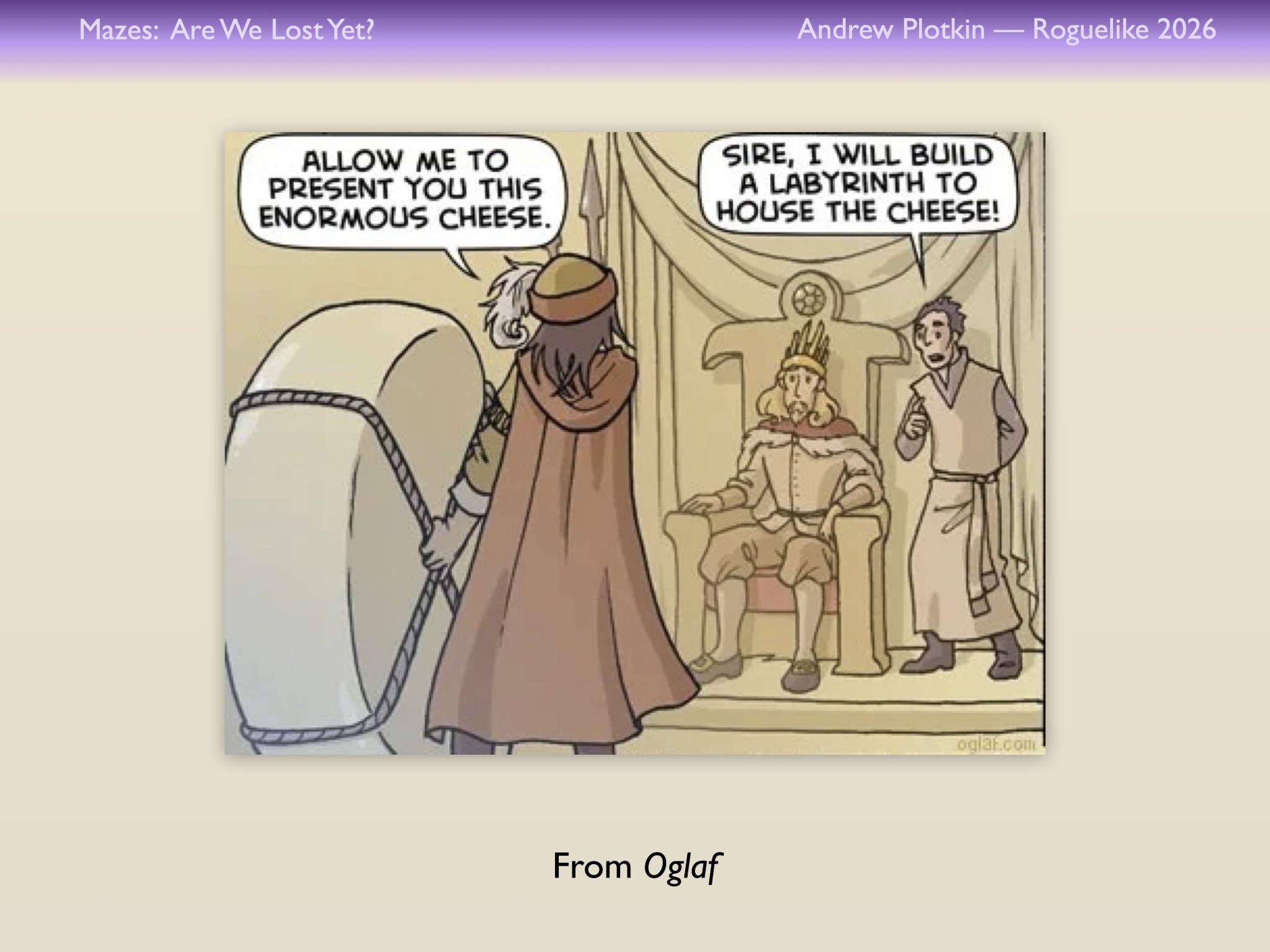
That feels a lot better.
You could quibble about the intentionality of Colossal Cave. The actual Colossal Cave, I mean.
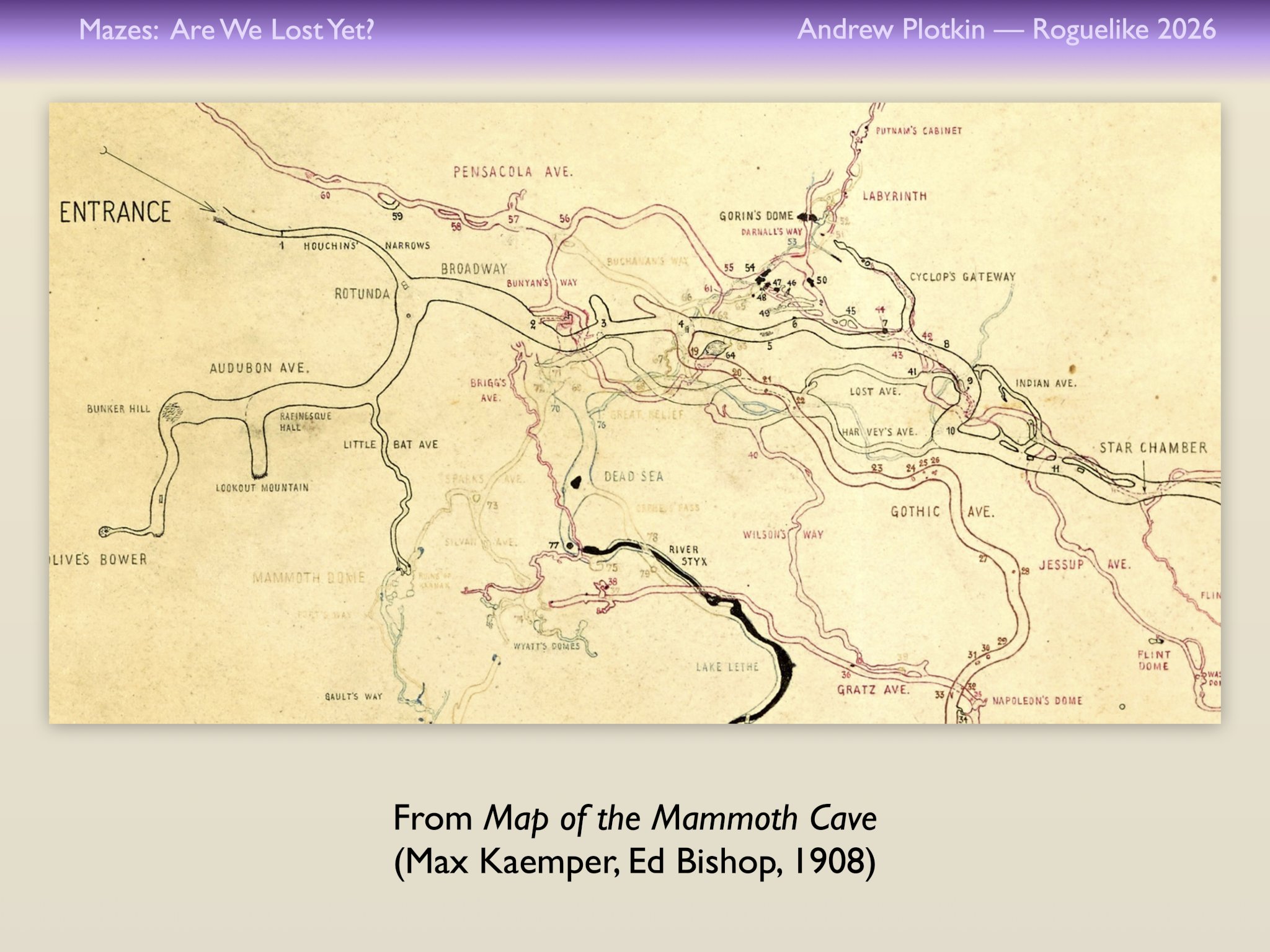
The mazes in the Colossal Cave game were inspired by actual caves explored by Pat and Will Crowther. They were confusing and you can get lost, but they weren’t created to get you lost. They were created by running water.
So that’s sort of a maze that doesn’t fit the definition. But my sense is that those caves are mazes by courtesy, like my doctor’s office. There’s a spot on this map labeled “Labyrinth,” but there’s also a spot labeled “River Styx”. It’s a metaphor.
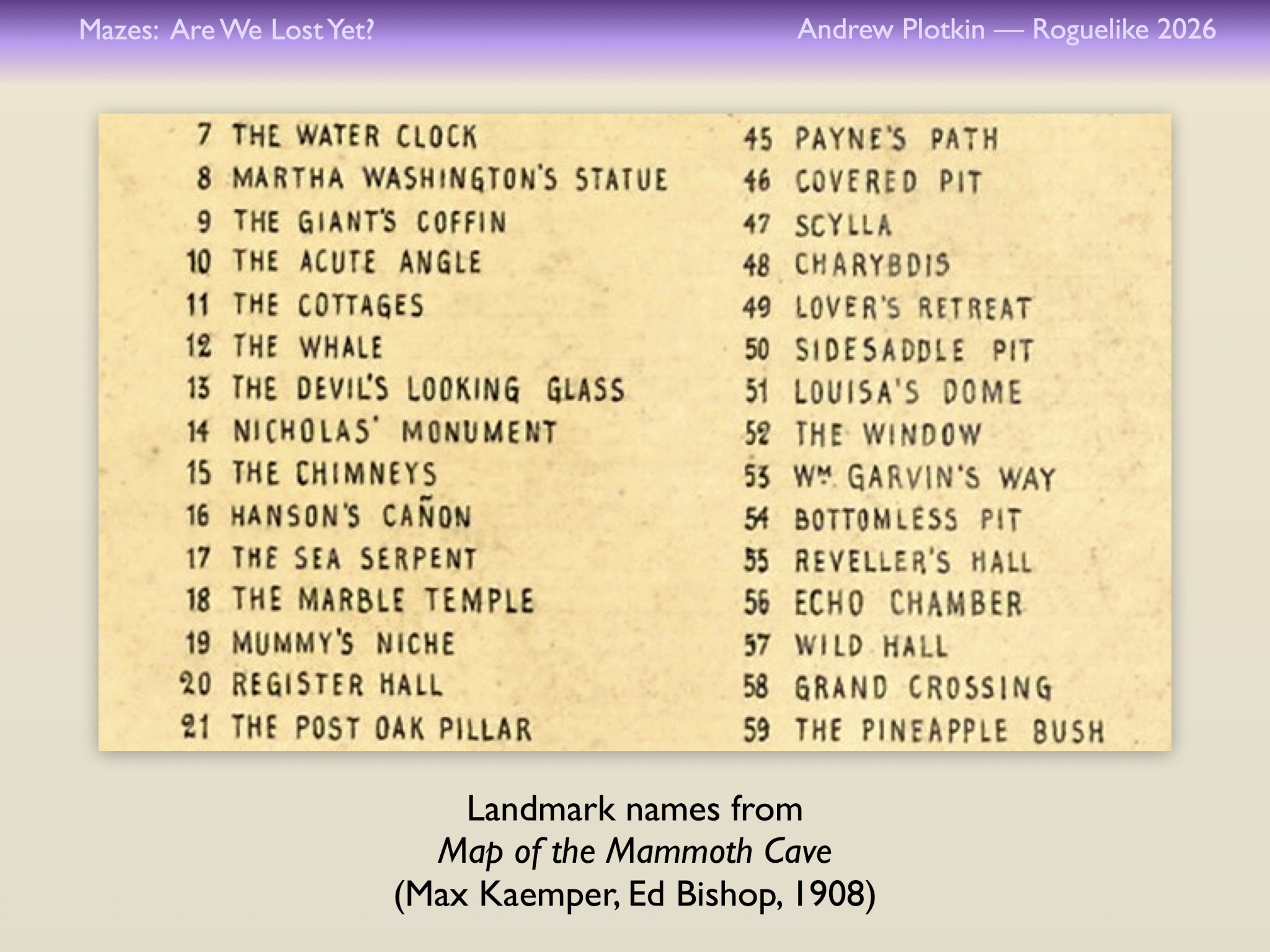
Cavers love metaphors.
So we can say that a maze is a space which is designed to get you lost. Except there’s a small problem with this definition too!
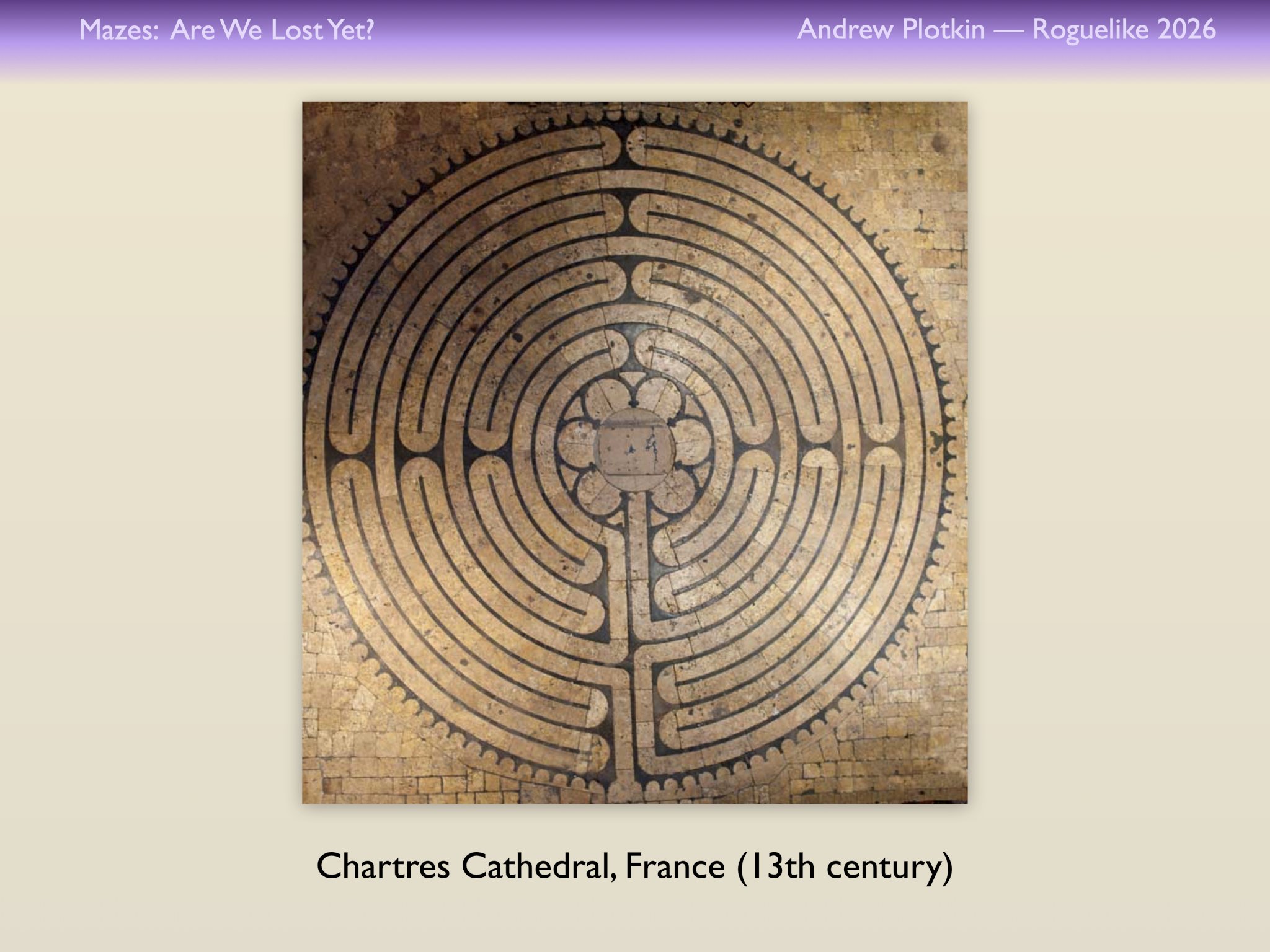
This is a maze, but you can’t get lost in it, because it has no branches. You enter and follow a single path until you reach the center. This is called a “unicursal” maze, which just means “one path”.
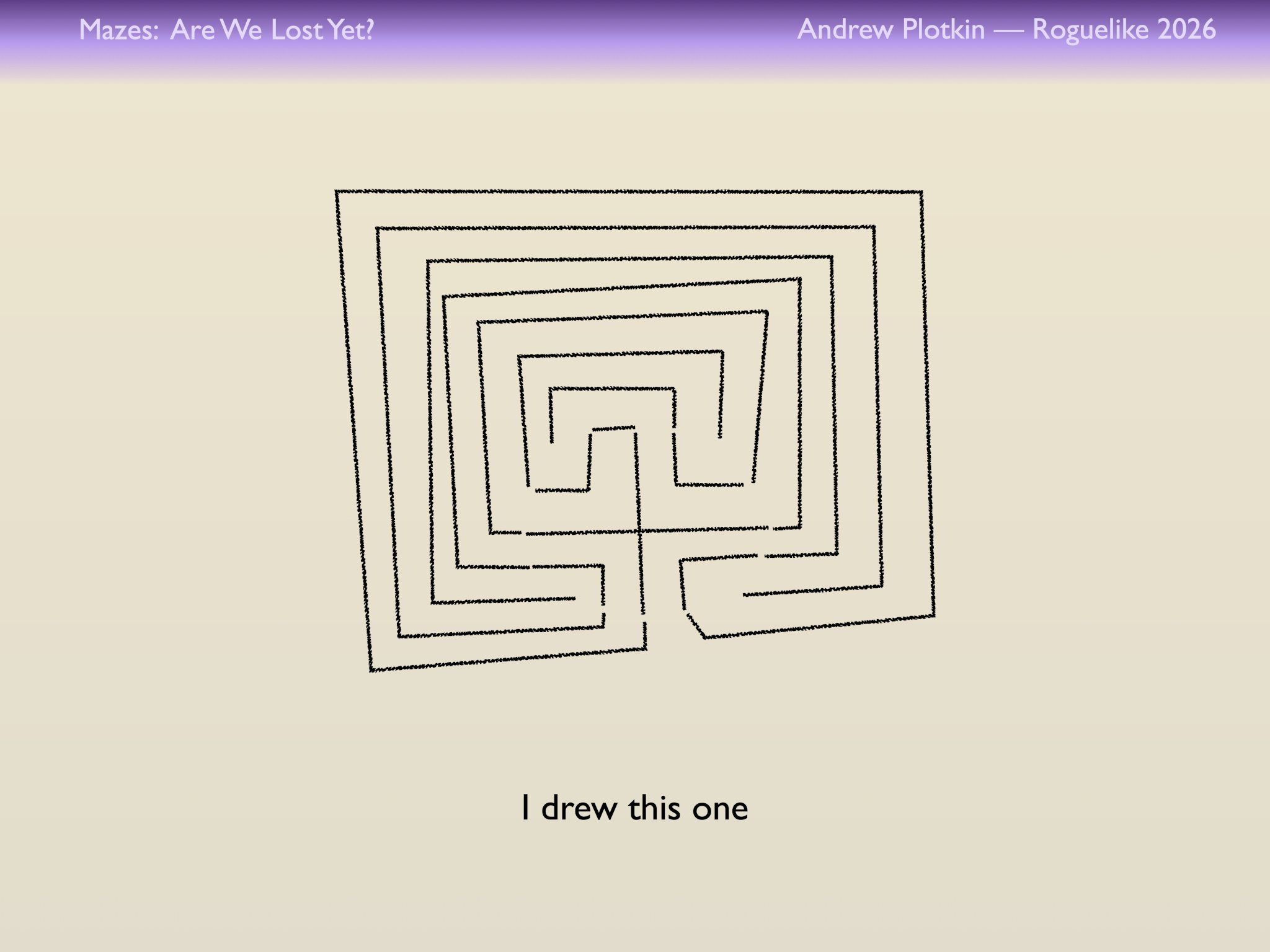
Here’s another one.
You might say that’s not a maze, it’s a labyrinth. But I’ve given up correcting people about that. They just turn and give you this look like one of you just turned into a penguin and they’re not sure which it is.
The fact is, the distinction between “maze” and “labyrinth” is not very meaningful to most people. In common parlance they’re synonyms. I think that common definition should guide our definitional fussing around. We shouldn’t ignore it.
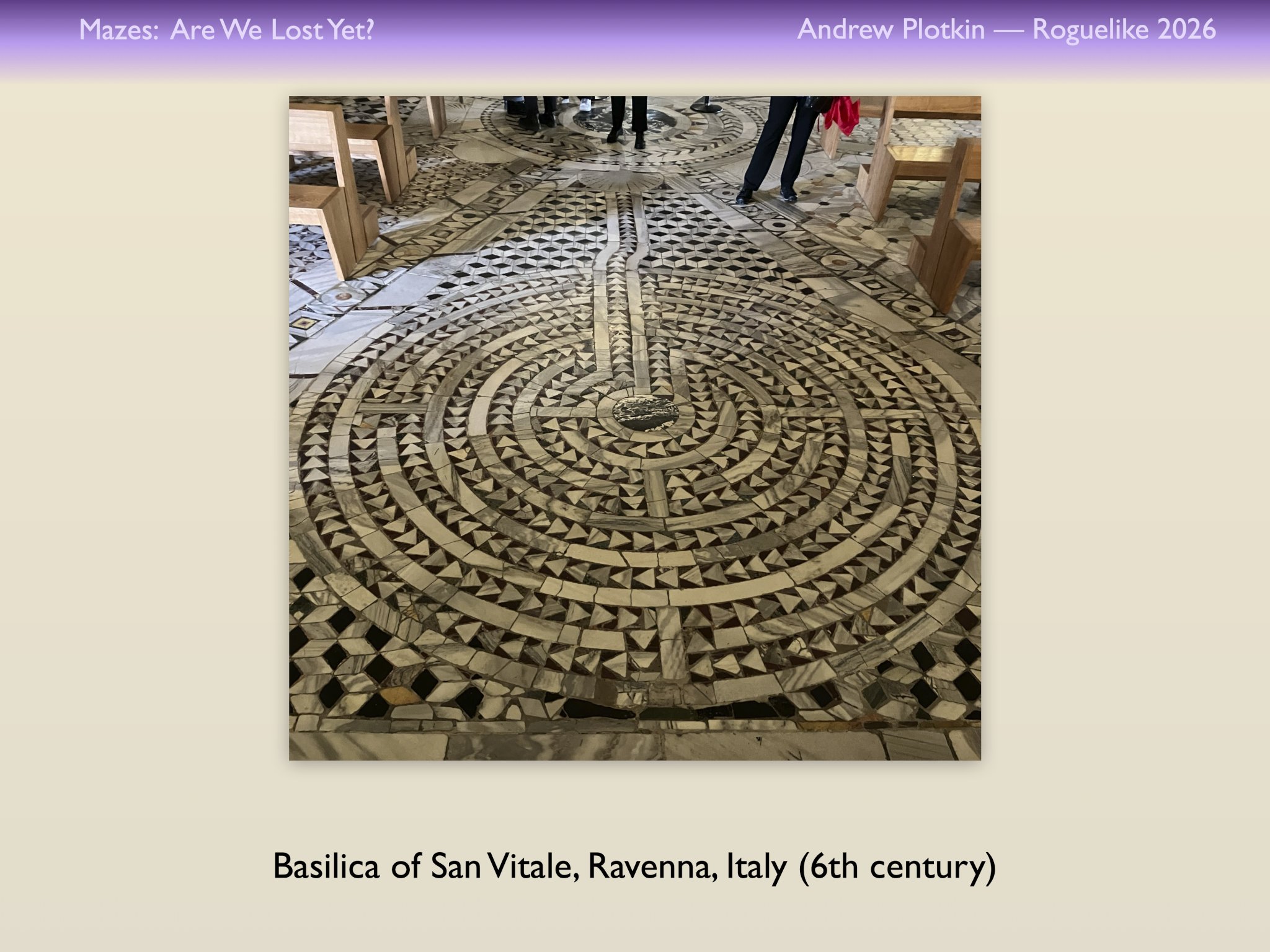
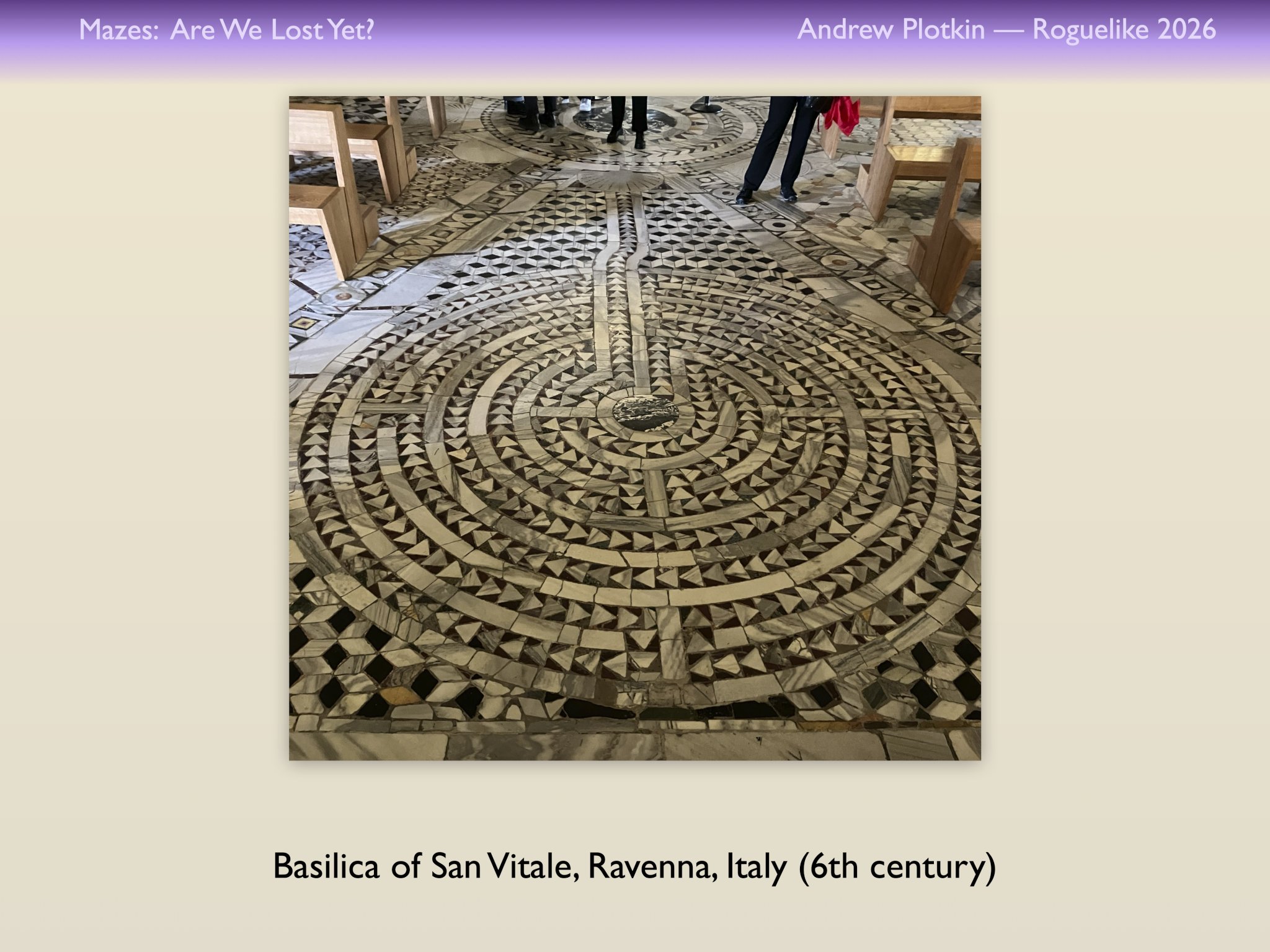
I took this photo on a trip to Italy a couple of years ago.
By the way, if the triangular tiles on the path are arrows, then you’re supposed to start in the center and find your way out. That’s not how we usually think of mazes… or labyrinths. I wonder if the people who made the Chartres maze thought the same way.
So why are these mazes if you can’t get lost? Maybe you can get lost! A unicursal maze like this is actually pretty hard to follow. I mean, if you try to trace it, what do you do? You put your finger on the path and you squint and follow it around, and you try not to lose your place. “Losing your place” and “getting lost” are the same concept, right?
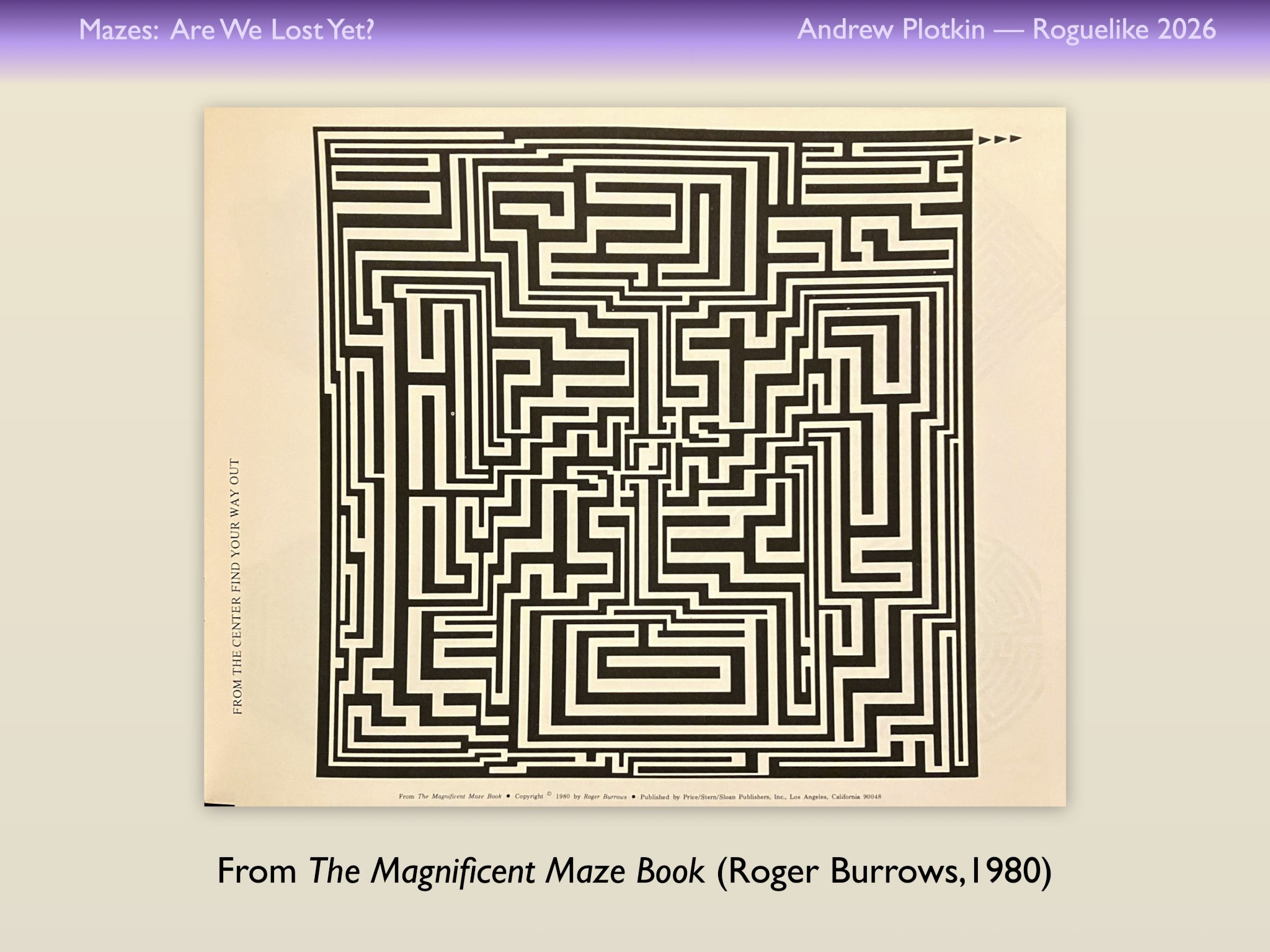
This is a classical branching maze, but really it’s largely the same experience. You follow a path by squinting and pointing and trying not to lose your place. Sometimes you also have to decide which branch to take, but this maze has relatively few branches.
You start in the center in this one, too, by the way.
So we’ve come around to a subjective definition.
A maze is a feeling. The feeling of being lost, the feeling of being disoriented, but also the feeling of trying to orient yourself.

You can be disoriented in a big empty space, but that’s not a maze. You can’t orient yourself in a void because you have nothing to work with.
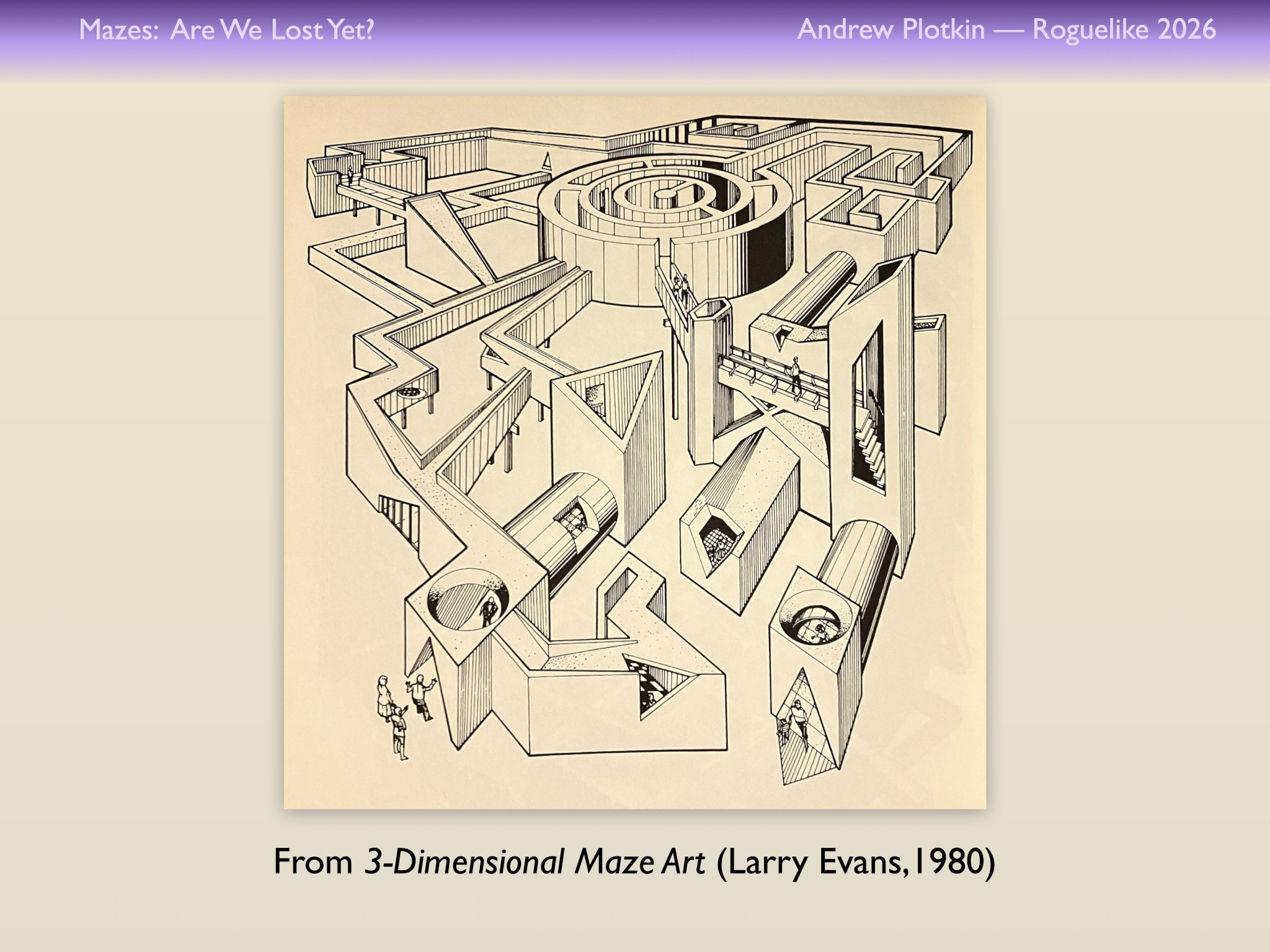
One reason I love this guy is that his mazes invoke the feeling of the first-person experience. You can’t see this diagram without imagining yourself in that space, walking on the paths. It’s not just lines. You can ask yourself, “Have I seen that bench before? Have I crossed that bridge? Have I seen that bridge from below?”
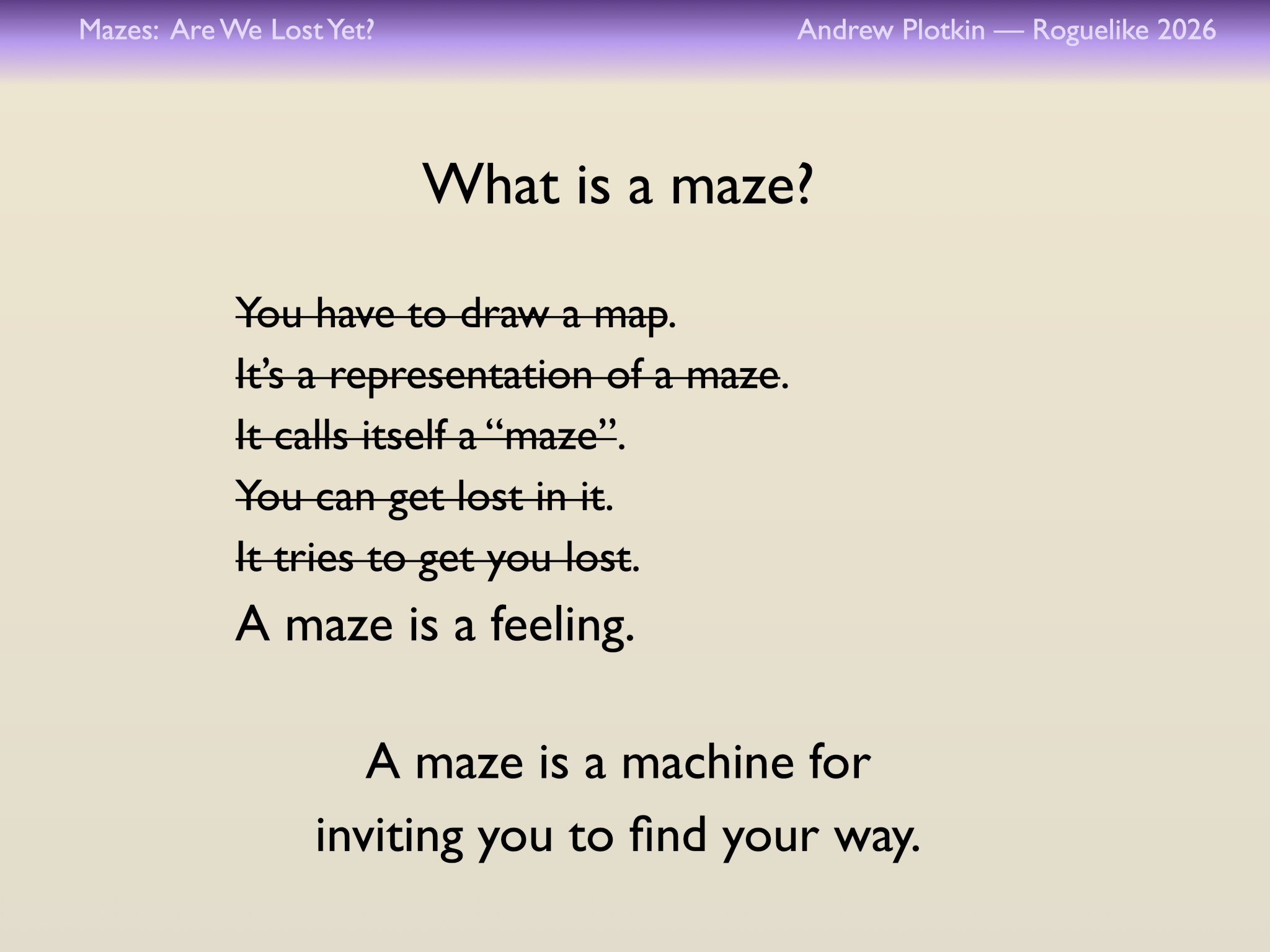
A maze gives you clues. The point is not for you to get lost; the point is for you to succeed at getting yourself unlost.
If your surroundings are almost all the same, but you can find landmarks, you might be in a maze. Because it’s making you work for it.
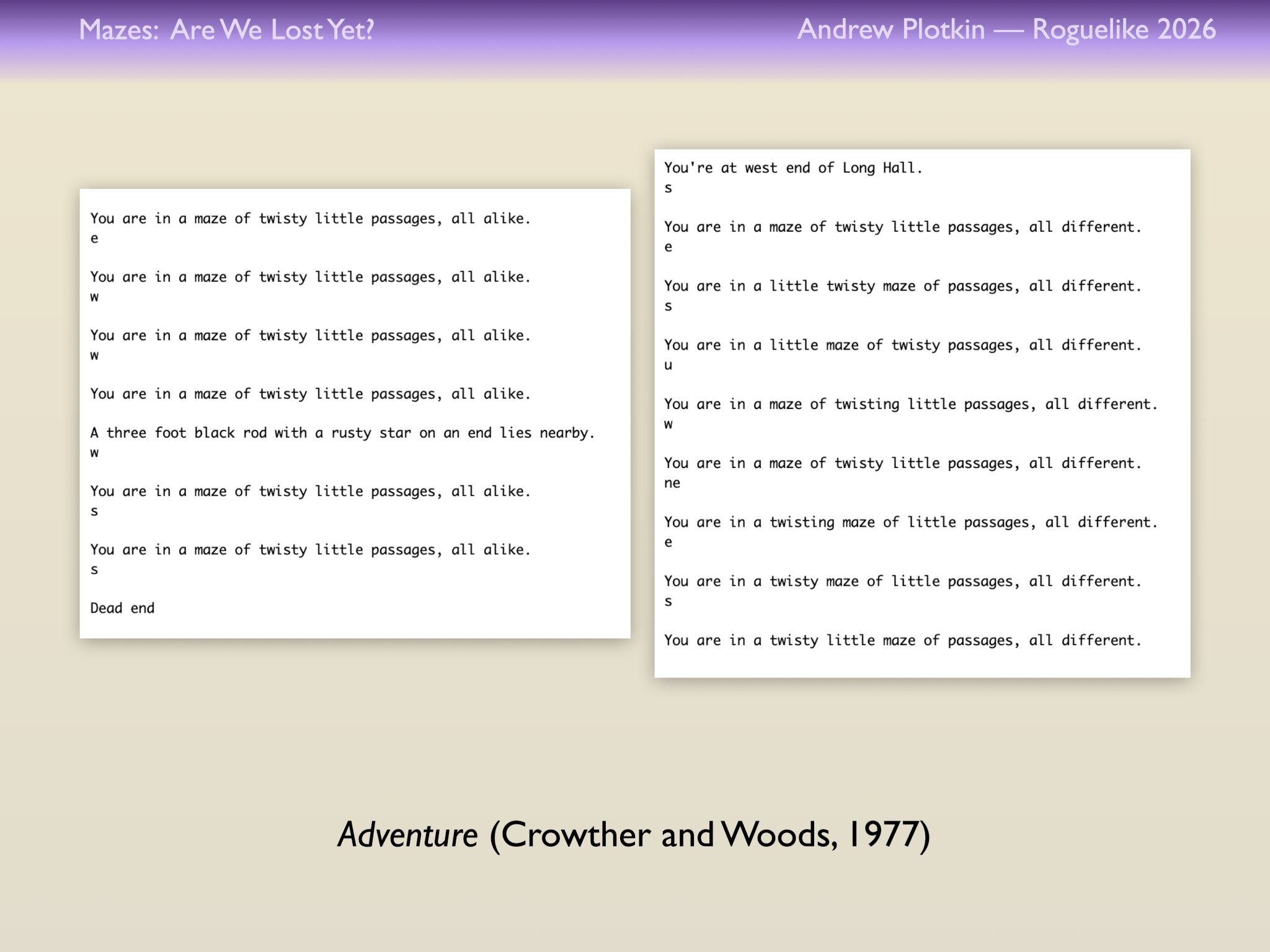
In the first Colossal Cave maze, there are no landmarks, but you can make landmarks by dropping objects.
In the second maze, you might start by dropping objects, but then you notice that the rooms really are different. But they’re different in a way which is difficult to keep track of. You have to work at orienting yourself in a new way.
Colossal Cave is such a classic that people don’t always remember that the second maze subverts the idea of the first one!
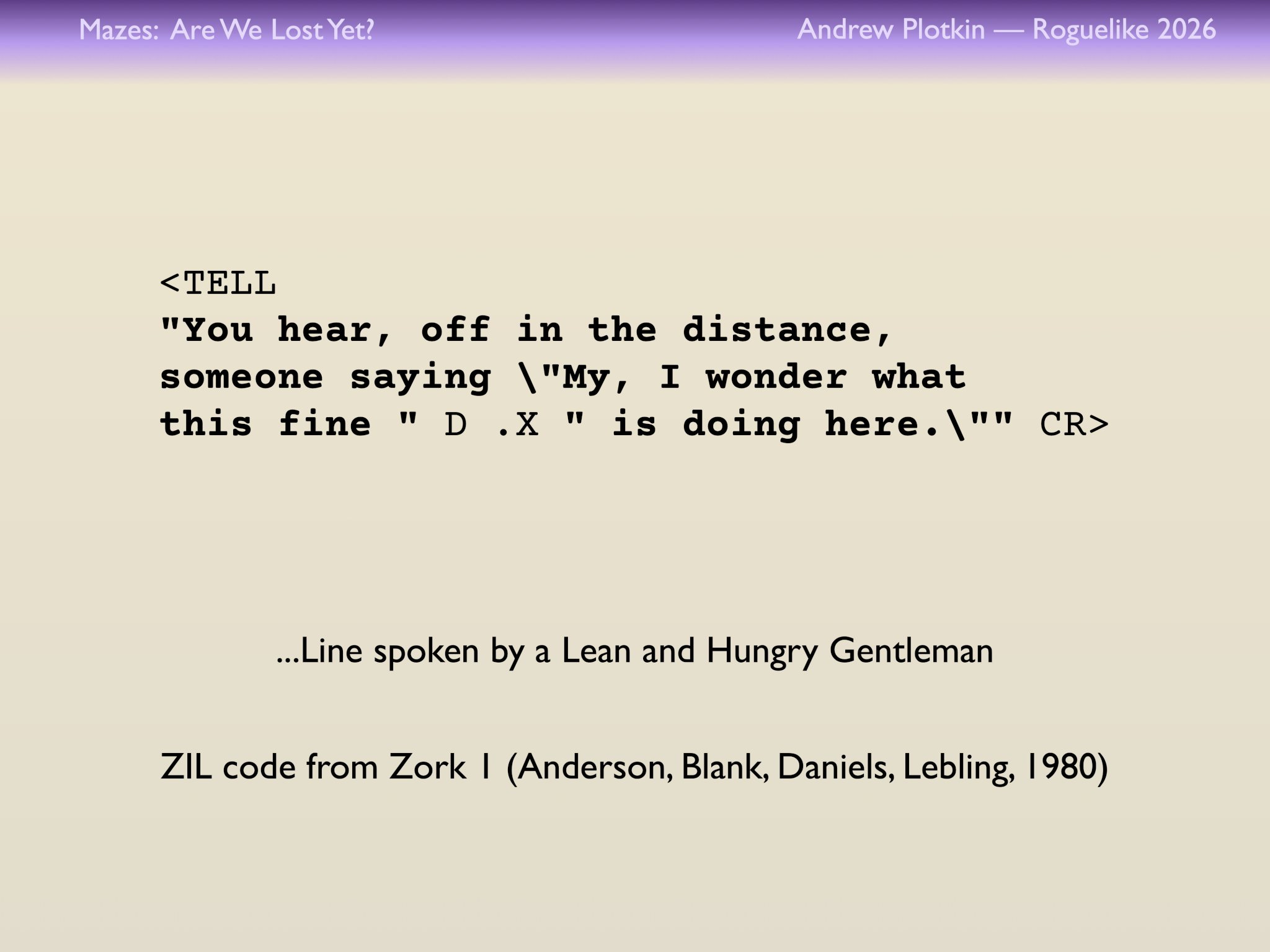
Zork subverts the idea differently. You can drop objects, but then the thief comes along and moves them. This is a line from the Zork source code that’s supposed to play when he does it. Actually some versions have a bug where this doesn’t work, but it’s supposed to.
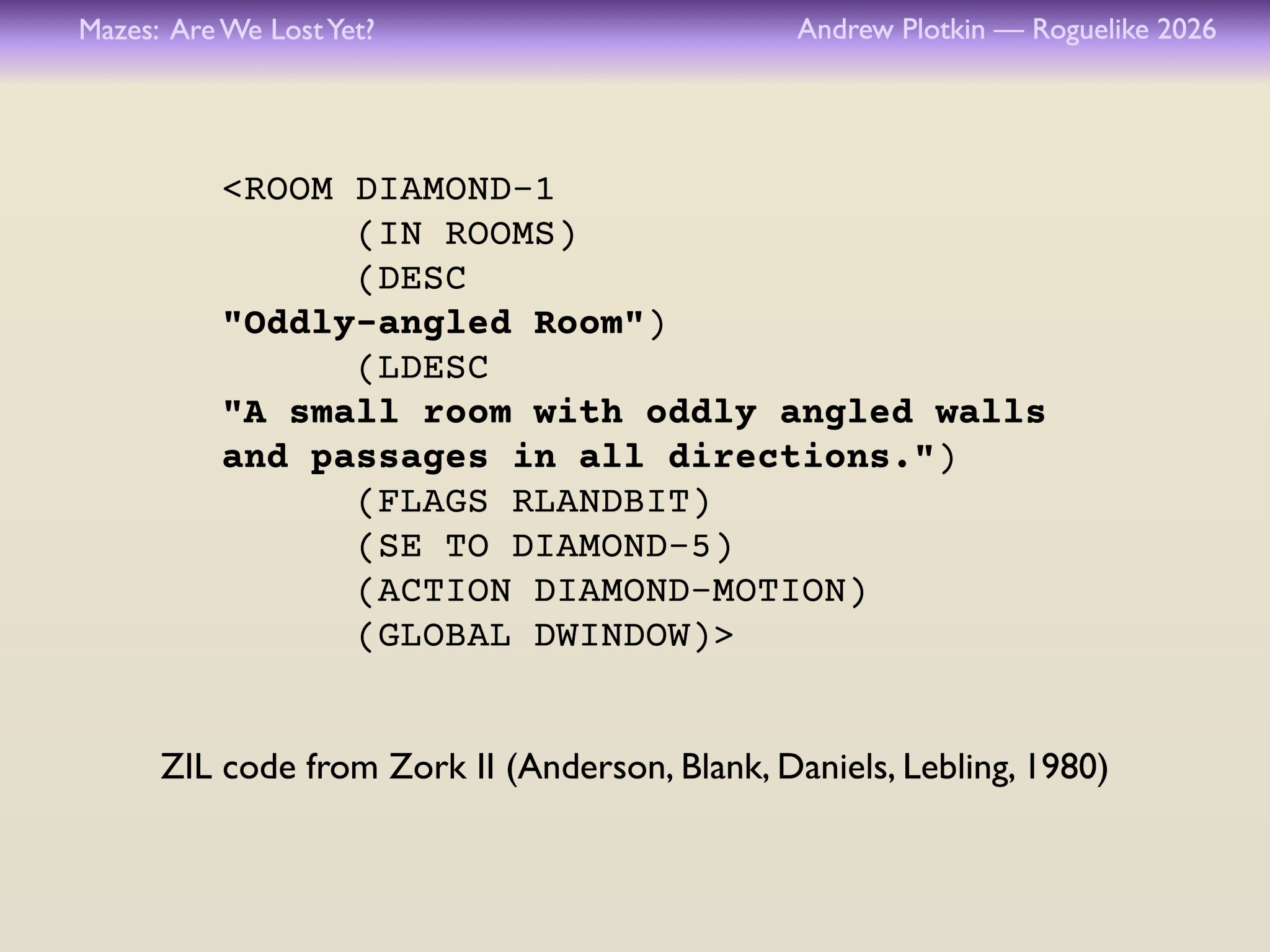
Zork 2 has yet a different subversion. I won’t spoil this one. But really, every single adventure game of that era that features a maze with a new and different surprise twist. Enchanter has a reconfigurable maze, Myst has audio clues, and so on. You can’t rely on your assumptions. You have to work for it.
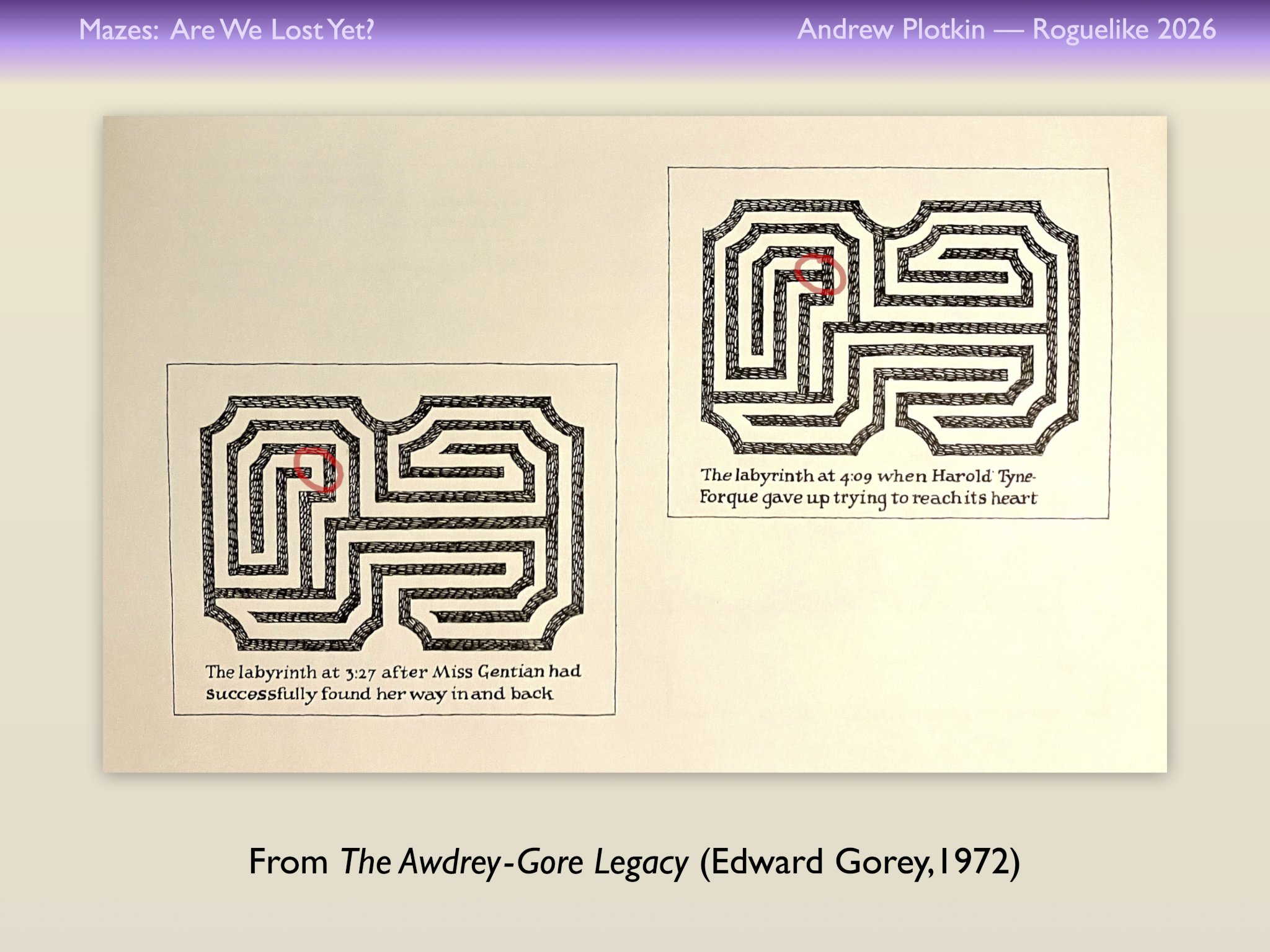
Or the maze could cheat. Or you could cheat.
I’ve shown you all these prints from Larry Evans mazes, and now one from Edward Gorey. I was halfway through writing this talk when I remembered that Gorey and Larry Evans collaborated on a puzzle book!
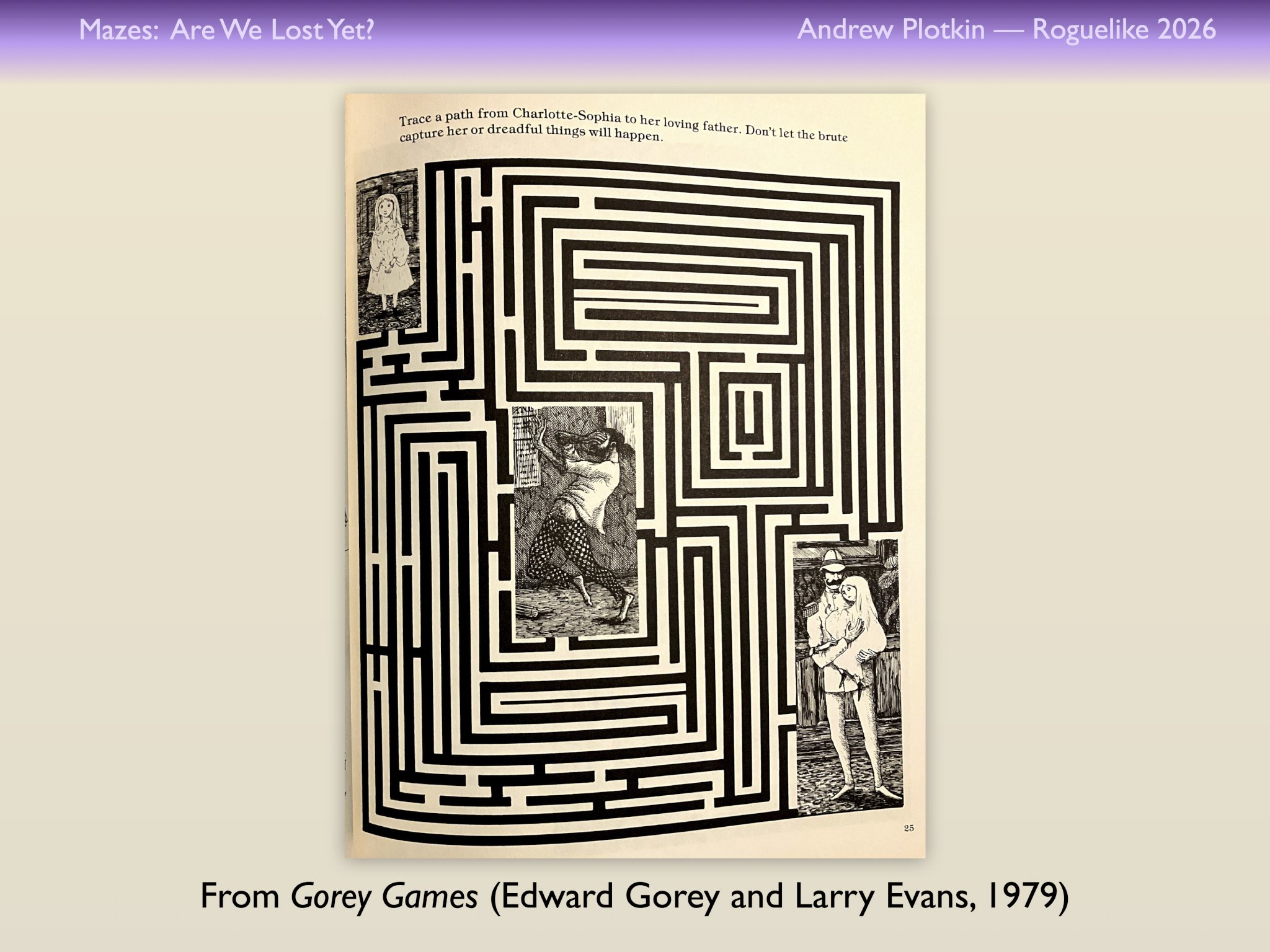
Or Larry Evans was hired to do a puzzle book with Edward Gorey art, anyhow. I had to put in this slide just to show you the crossover.
By the way, with all these digressions and dead ends, you might reasonably wonder if I know where I’m going with this talk. Maybe I’m just blundering down blind alleys, hoping that if I try enough topics, I’ll stumble across the way out of this presentation before my time is up.
That would be a rude accusation.
Accurate though.
…Okay, try this. I said that a maze makes you work at it, but a maze doesn’t have to make you work hard.
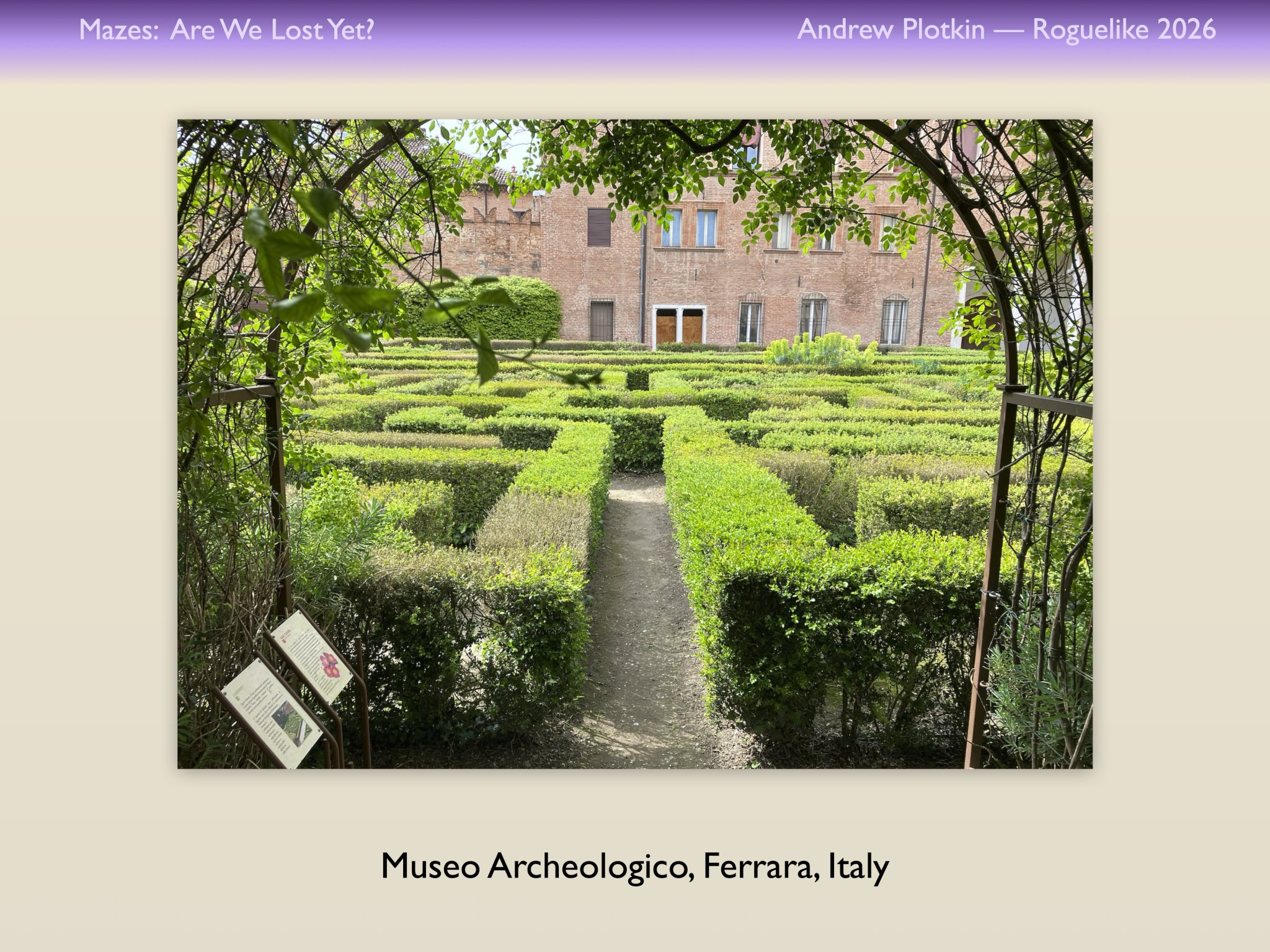
This is another photo from my Italy trip. This is a hedge maze which is waist-high. You can see over hedges (unless you’re notably short). You can’t walk across the lines, the way you can in a pavement maze, but it doesn’t obstruct your view either. Finding your way through this is fun, but it’s not difficult.
Stop. Strike that. Reverse it. Finding your way through this isn’t difficult, but it’s still fun. You’re still having the maze experience.
When you find a pavement maze, it’s not an obstacle. There’s no walls; there’s no prize for solving it. Nothing forces you to engage with it. You engage with it because mazes are great. You solve it because you want to solve a maze.
So that’s why you should put mazes in your game: because mazes are great.
Now, that’s not the whole story. Mazes are beautiful when they challenge you. Game design is beautiful when everything is there for a reason. I know that statement is infinitely flexible. There can be all sorts of reasons, including artistic ones. But I enjoy puzzle games where for every element, there’s a moment when you say “Aha, that’s what that connects to.”
So, if you put a maze into your puzzle game, and there’s no obvious reward for solving it, that has all sorts of fun implications. Players will look for the unobvious reward.
If the maze is purely decorative, then in a game-design sense it’s a red herring. You’d better label it very clearly as a red herring.
Otherwise players might spend a lot of time looking for something that isn’t there, which is a bad play experience. If they spent a lot of time looking and then find something, that’s a good play experience – at least, the puzzle sickos will appreciate it. But if there’s nothing, you will get some nasty letters.
So if there is a meaning in your decorative maze, what might that be?
Maybe the correct path through the maze passes a sequence of landmarks. Then that sequence could be a clue; it could be be useful elsewhere.
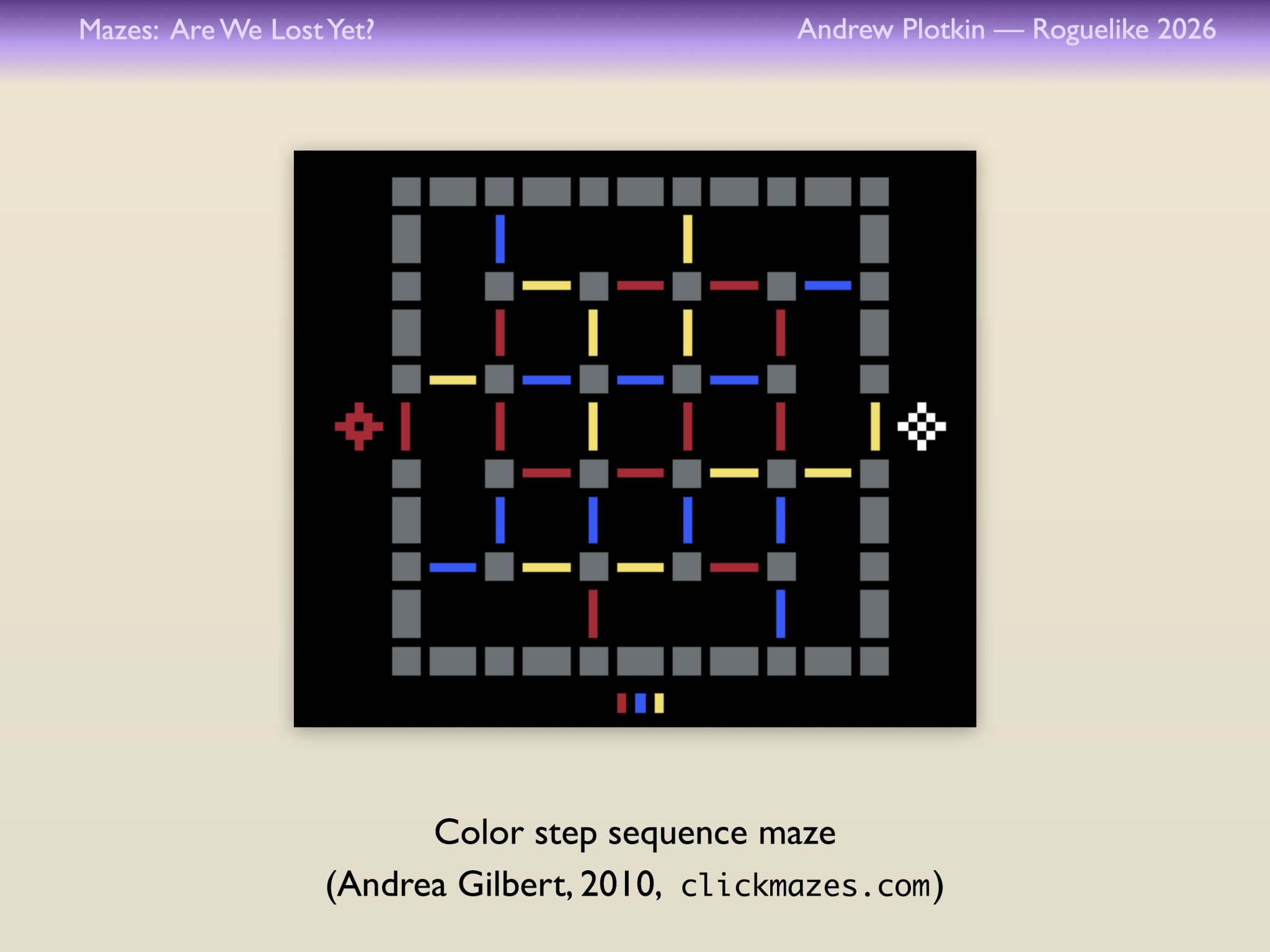
Maybe the maze has a rule. Rule mazes, or logic mazes, are a whole maze category that I don’t have time to get into. These are puzzles which are based on a maze but with some additional constraint. For example, a color sequence. In this example, you have to go red-blue-yellow, red-blue-yellow until you reach the exit.
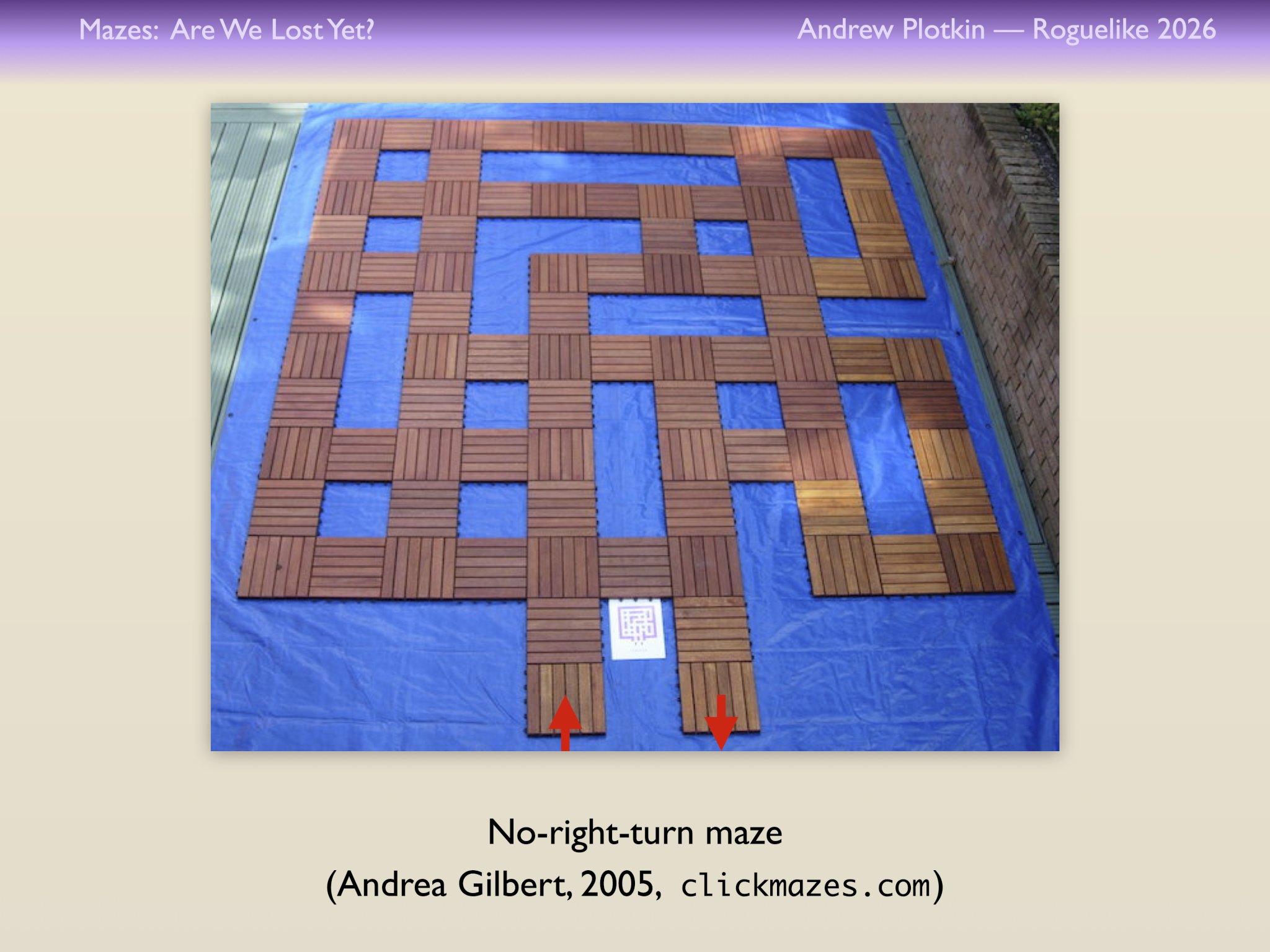
This is a left-turn maze. You’re only allowed to go straight or turn left. You’re not allowed to double back or turn right.
Logic mazes are not my favorite kind of maze. That’s a personal preference. I’m not excluding logic mazes as a category of maze.
But you can probably tell that I’m into the environment-ness of mazes. The point of logic mazes is that you can come back to the same place but you’re facing the wrong way, or you’re on the wrong color, so it’s a different state. That can be a good puzzle (and I like puzzles) but it distances me from the maze as a place.
However, where there are rules, there is rule discovery.
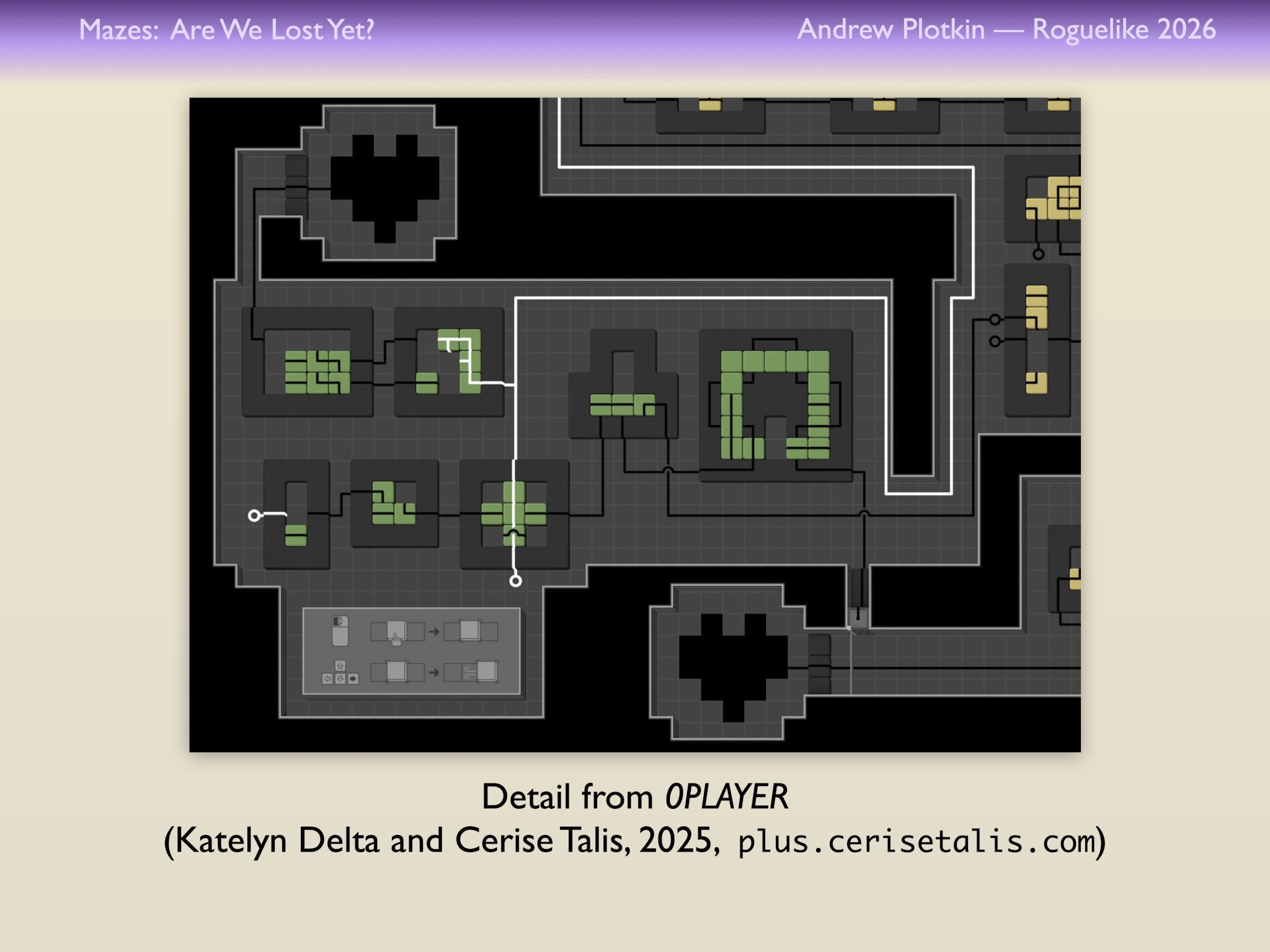
Rule discovery is a large and productive category of games, perhaps launched by The Witness. This is 0PLAYER, an example of a non-interactive rule discovery puzzle.
Rule discovery might mean playing a logic maze backwards.
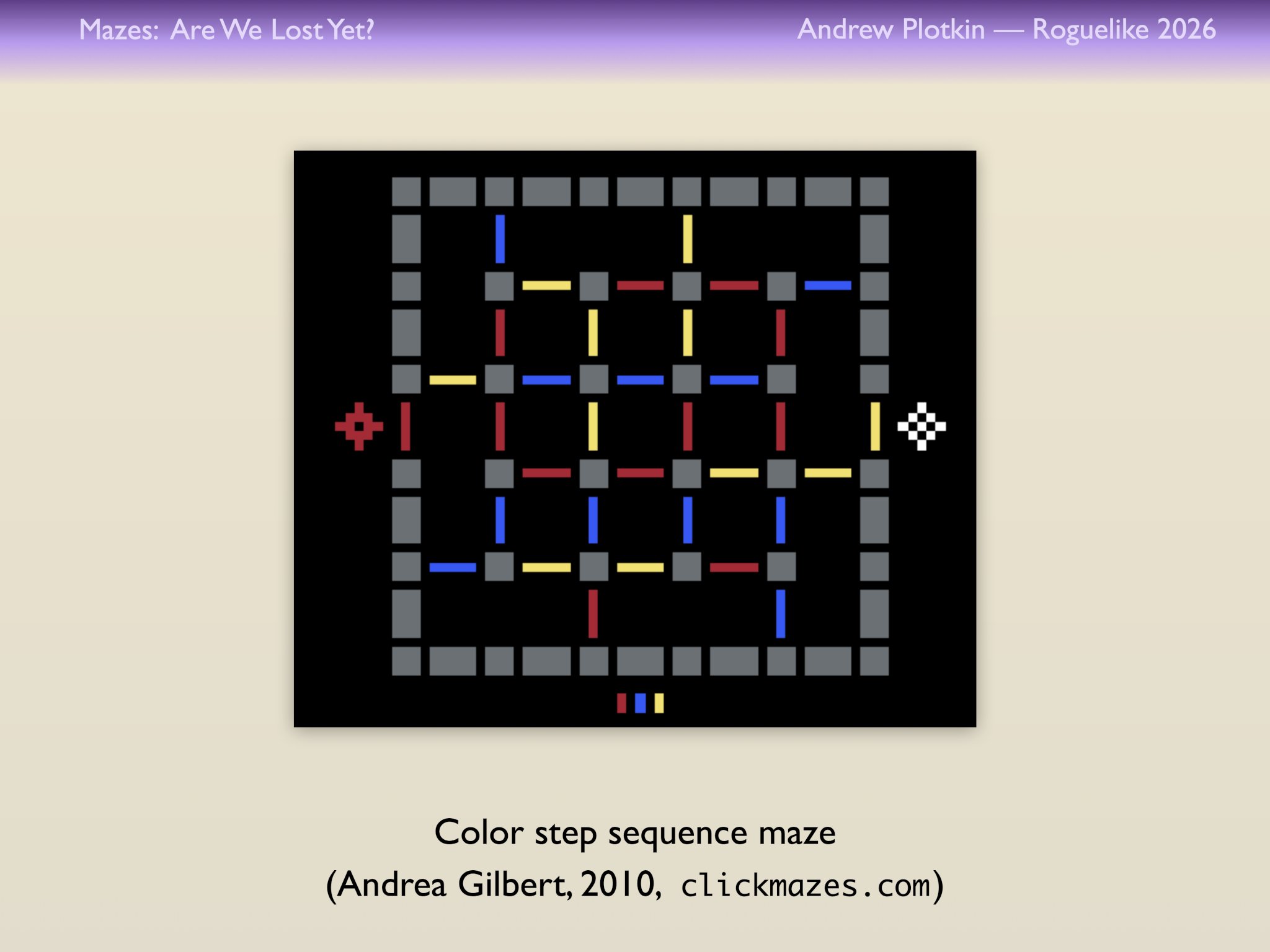
If I showed you this maze but didn’t tell you the rule, could you figure out what the rule was? Maybe! If you ignore the colors, it’s not a maze. If you pay attention to one color at a time, it’s a very simple maze. If you decide it’s about color alternation then you clearly must start with red. If you go red-yellow-blue, the solution is too easy; it’s a bad puzzle. If you go red-blue-yellow, it’s a good puzzle.
So this maze by its very nature is a clue indicating red-blue-yellow. Maybe that sequence is a clue which you need elsewhere in the game.
(Of course a three-color sequence isn’t a good clue, but that’s just an example. You could expand on this.)
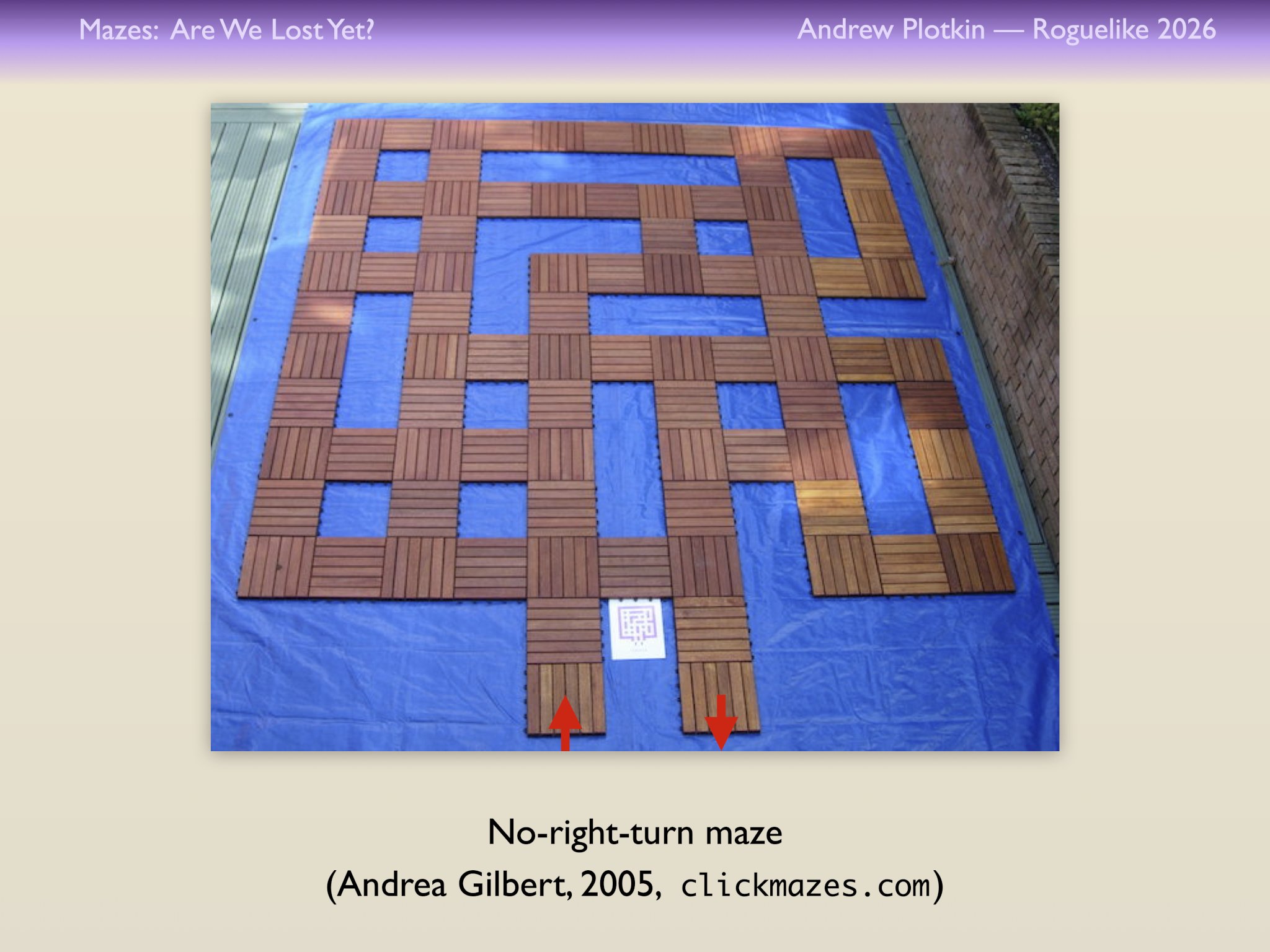
If I showed you this maze and didn’t explain that it was left-turn only, could you figure that out? I couldn’t. But somewhere out there is the sicko who could, and maybe that’s your audience.
I think at this point I am going to cheat and cut through the hedge to the exit.
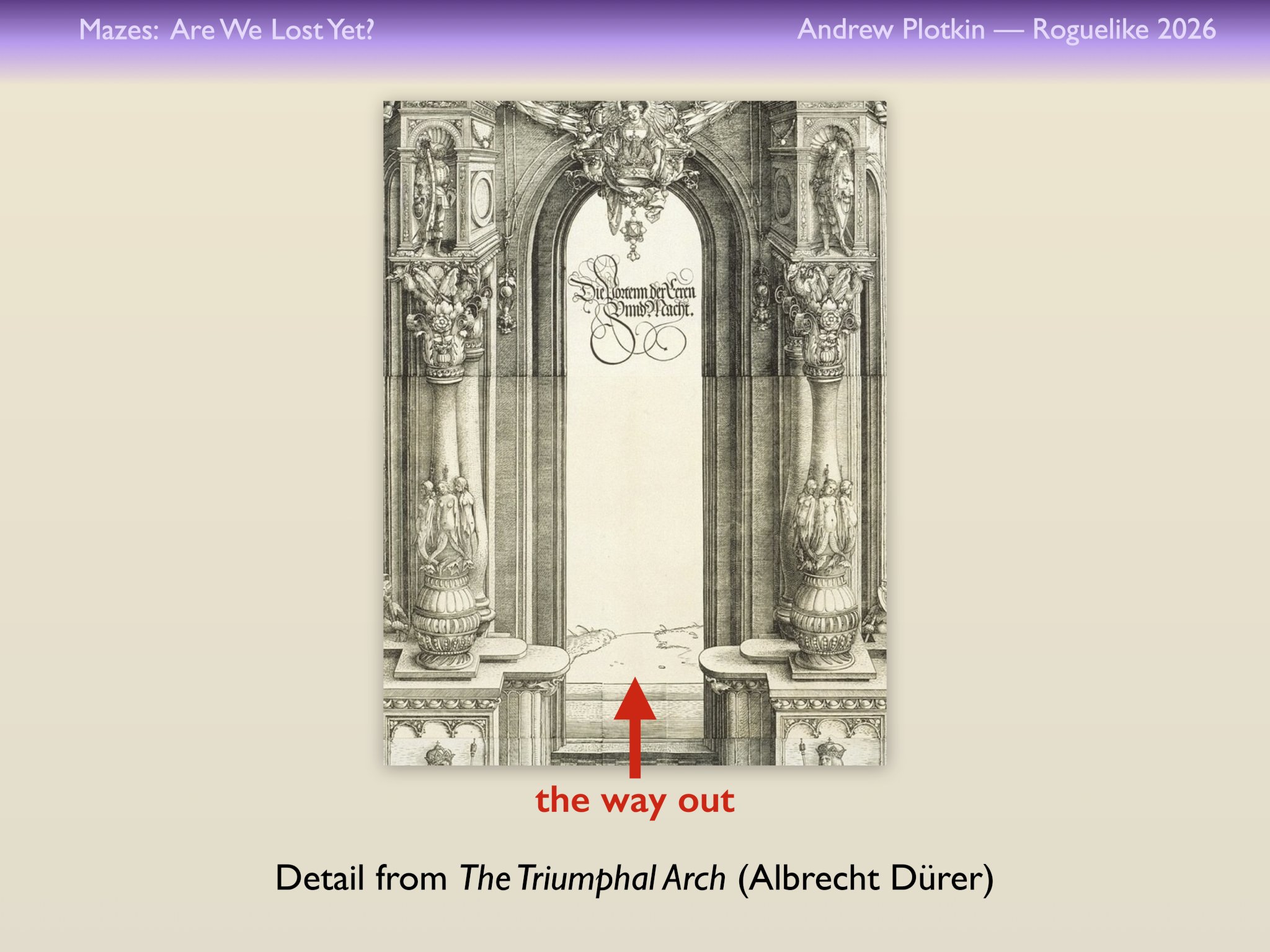
I hope you’ve enjoyed this ramble through my favorite mazes. Thank you for listening.
When I originally gave this talk, I arranged the slides in a two-dimensional grid which – of course – formed a maze. Here is a scrollable view of that grid.
See my contact page for these links.
Postscript: While I was speaking, Kate Compton made this adorable little maze-shelled snail critter.
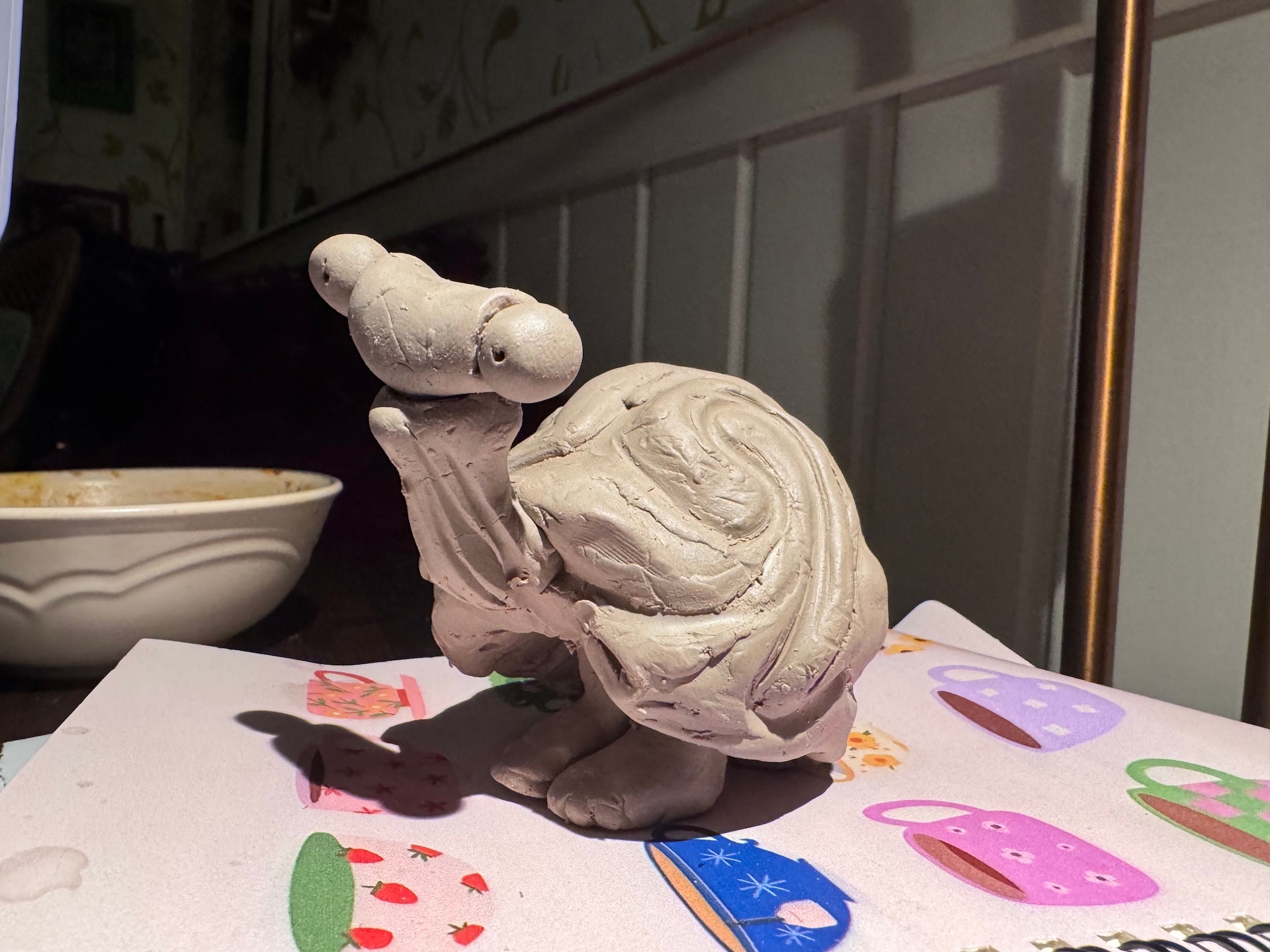
I made some little guys during the #roguelikecel talks, for @eblong.com mazes, and @everest.bsky.social’s deep dive into holes
[...] I think their name is Mel (short for Melodica) and i dont know why
-- @galaxykate.bsky.social
Last updated October 18, 2026.